
SDG 15 Universitas Jember 2025
UNEJ's Actions in Supporting the Achievement of SDG 15 in 2025
15.2.1 Conservation and Sustainable Utilization of the Land, including Forests and Wild Land
UNEJ conducted a land conservation initiative by planting 500 mangrove trees at Tanjung Batu Beach, Situbondo, on 19 November 2025. This initiative supports coastal ecosystem restoration and biodiversity conservation. The planting of 535 trees in Jubung on 17 November 2025 also contributed to land conservation efforts. In August and December 2025, UNEJ, through its Faculty of Agricultural Technology and Faculty of Pharmacy, collaborated with Meru Betiri National Park (TNMB) on forest conservation initiatives. Another sustainable land-use policy is replacing congratulatory flower arrangements with tree seedlings, reducing land-based waste while encouraging continuous tree planting and environmental restoration.
Routine Conservation Activities at TNMB (Including Student, Faculty, & Partner Involvement)
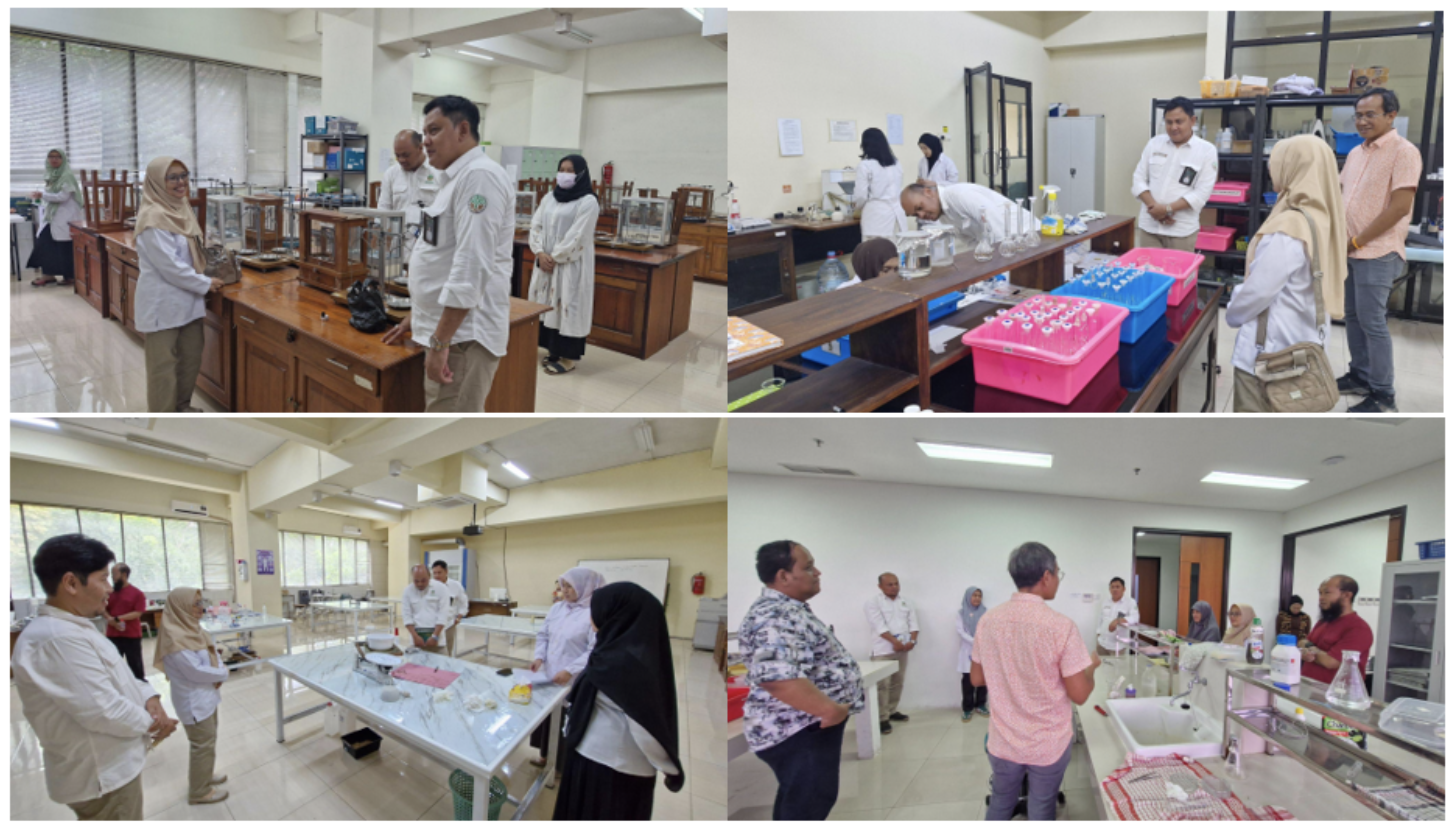
Fig. Collaboration activity between UNEJ and TNMB
Academic faculties across Universitas Jember most notably the Faculty of Mathematics and Natural Sciences (FMIPA) and the Faculty of Pharmacy maintain active, long-term research partnerships with Meru Betiri National Park (TNMB), exemplifying the university's deep institutional commitment to preserving pristine natural ecosystems. Through formal conservation agreements and ongoing field programs, UNEJ routinely deploys student-faculty research cohorts into TNMB’s protected tropical forests. These teams conduct critical conservation work, including monitoring forest biodiversity, cataloging endemic plant species, and assessing habitat health to support national park authorities in maintaining ecological stability.
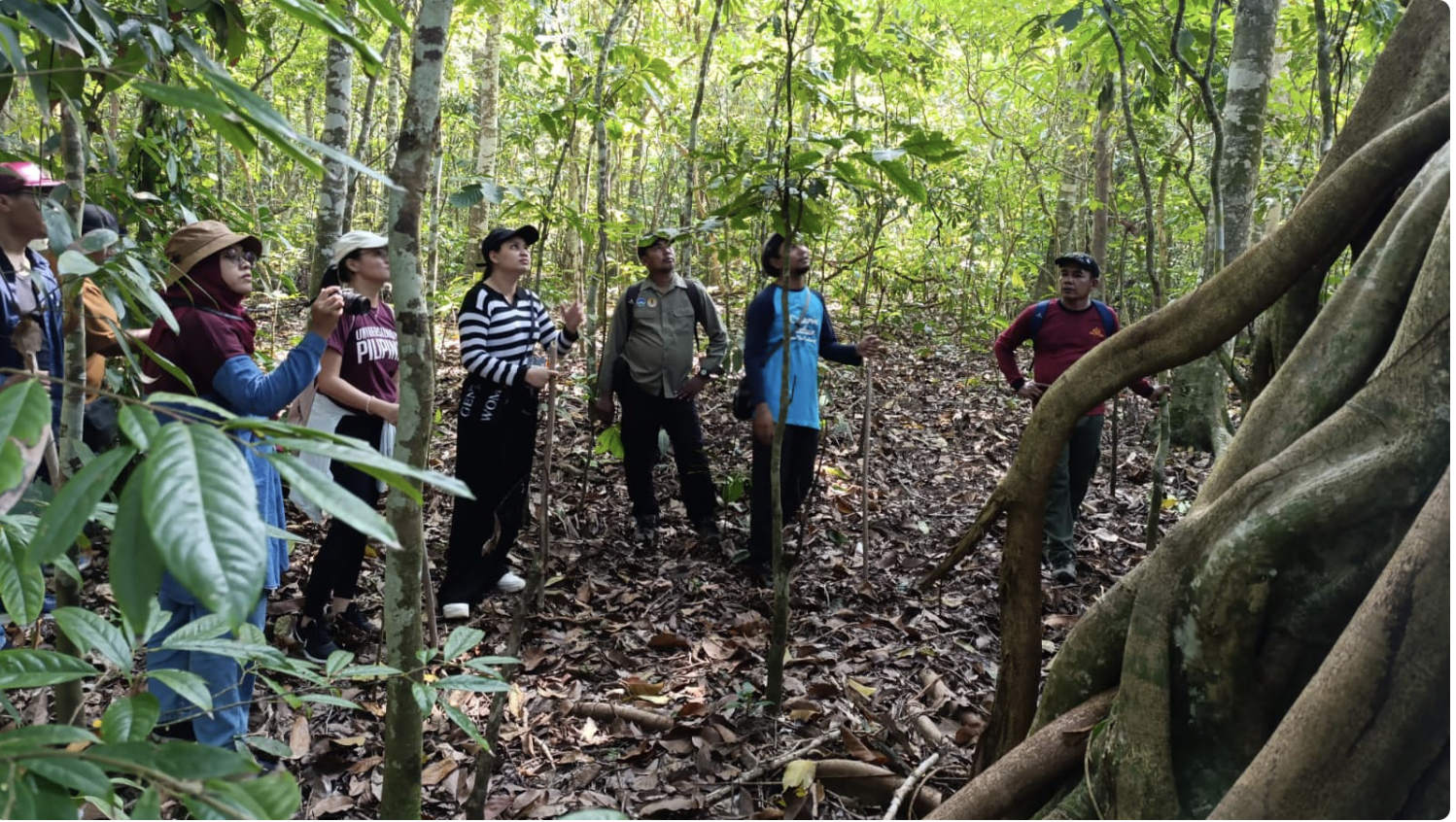
Fig. UPLB Philippines - TNMB - UNEJ implement community-based forest conservation.
This routine field presence serves a dual institutional purpose: generating vital scientific data for regional biodiversity management while serving as an immersive training ground for future conservation leaders. Students participate directly in wildlife tracking, botanical documentation, and ecological threat assessments, turning theoretical ecological principles into actionable environmental protection. By embedding multi-disciplinary research teams within TNMB on a continuous basis, UNEJ reinforces its structural role as a leading academic guardian of tropical forest conservation in East Java. This activity is a continuation of the previous initiative, in which Universitas Jember (UNEJ), the University of the Philippines Los Baños (UPLB), and Meru Betiri National Park (TNMB) collaborate to implement community-based forest conservation.
News Link: https://farmasi.unej.ac.id/blog/2025/12/06/sinergi-untuk-konservasi-dan-inovasi-balai-taman-nasional-meru-betiri-tnmb-dan-fakultas-farmasi-ff-unej-jajaki-kolaborasi-riset-dan-visit-laboratorium/
https://harian.disway.id/read/787800/kuatkan-pemasaran-ekowisata-di-tnmb-unej-dan-uplb-philipine-jalankan-konservasi-hutan-berbasis-masyarakat/15
Replacing Flower Boards with Tree Seedlings: From a Universitas Jember Policy to Its Practice
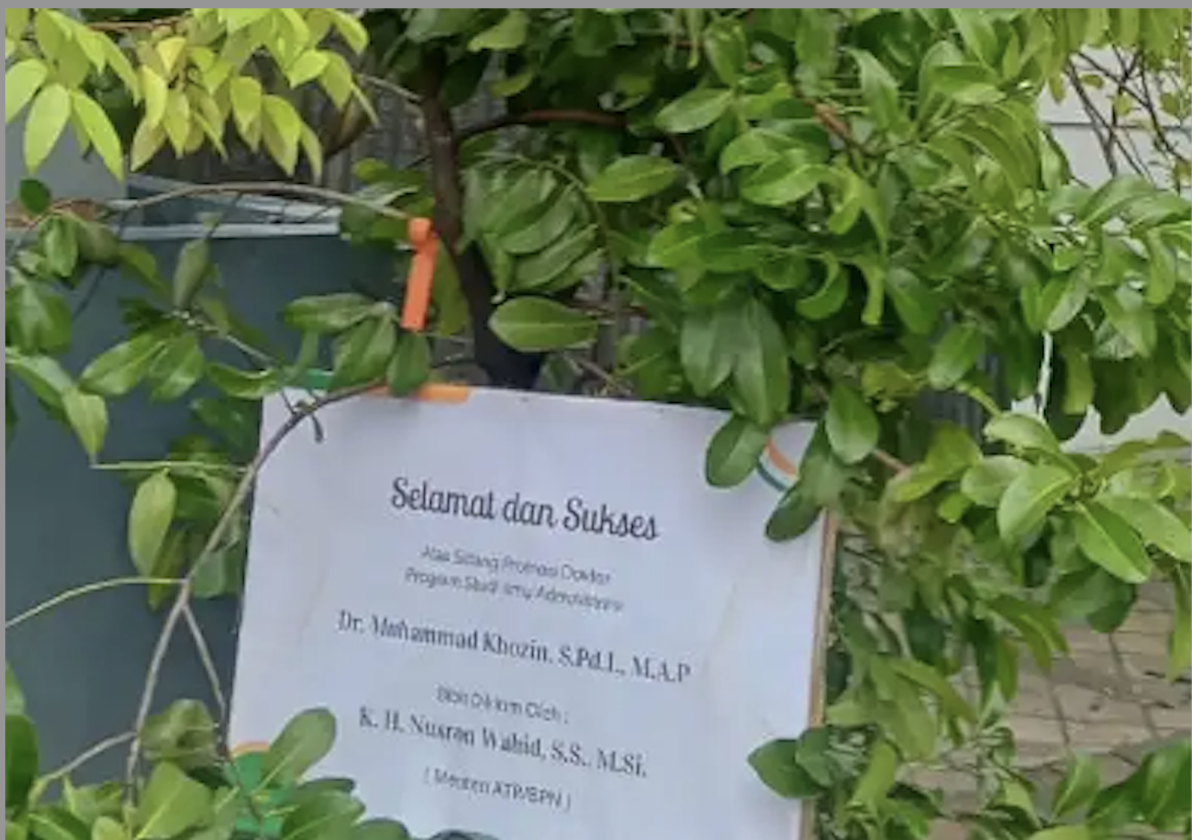
In June 2025, the Rector of Universitas Jember, Dr. Ir. Iwan Taruna, issued a circular (No. 3166/UN25/TU.02.02/2025, dated 3 June 2025) urging all faculty deans, institute heads, unit heads, and campus coordinators to replace flower boards with flower or plant seedlings from UPA Taman Agroteknologi. The goals were environmental conservation and sustainable campus development. After the event, the seedlings can be planted on campus or at the work unit. Hundreds of seedlings were placed at the Multimedia Mayapada building in support of the university’s Green Campus direction.
UNEJ Plants 535 Trees at Jubung Agroforestry and 500 Mangroves at Tanjung Batu Beach
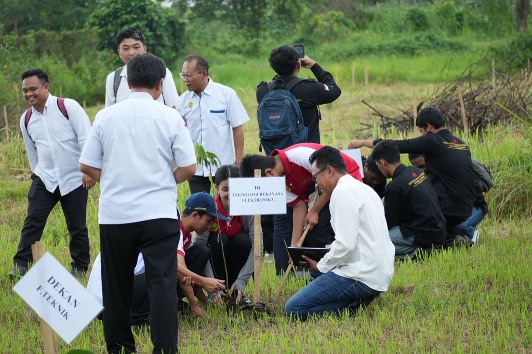
Fig. Planting Hundreds of Trees by Universitas Jember (UNEJ)
On 17 November 2025, Universitas Jember (UNEJ) held the Jubung Agroforestry event at its Jubung Vocational Campus in Jember, planting 535 trees of various productive and industrial species. The event involved the university community and several other universities in the Jember area, including UINKHAS Jember, Universitas Moch. Sroedji, and UNIPAR. These partners usually work with UNEJ on community service programs, which are part of the tridharma of higher education. The Vice Rector for Academic Affairs, Prof. Slamin, said the program supports campus sustainability and greening and will also benefit the surrounding community.

Fig. Mangrove planting at Tanjung Batu Beach
UNEJ planted 500 mangrove trees at Tanjung Batu Beach in collaboration with the Situbondo Regency Government to address coastal erosion and disaster risks. The initiative builds on previous mangrove planting across 3,750 m². UNEJ also emphasizes community-oriented coastal conservation, ensuring that fishermen retain access to designated fishing areas to prevent conflicts over coastal land use.
News link: https://rri.co.id/jember/regional/1982788/lp2m-unej-bareng-pemkab-situbondo-tanam-500-mangrove
15.2.2 Sustainably farmed food on campus
Universitas Jember (UNEJ) has policies to ensure that food on campus is sustainably farmed [Vice Rector's Circular Number 20452/2025 on 16 September 2025]. Under [Vice Rector's Circular Number 20451/2025, 16 September 2025] UNEJ requires canteen operators and event caterers on UNEJ campuses to give priority to food that is locally grown and produced under sustainable farming practices, such as organic or good agricultural practice certification, and to use product from the UNEJ Agrotechnopark Plant Garden outlet. Throughout 2025, Circular No. 4090/UN25/KP/2024 of 5 February 2024 remained in effect and continued to be applied. Every work unit was required to buy at least one snack item from the Faculty of Agricultural Technology business unit for each meeting, using products made from locally produced modified cassava flour. The Rector’s guidance reinforced this in 2025 by promoting local root crops, namely boiled cassava, sweet potato and taro, as official refreshments.
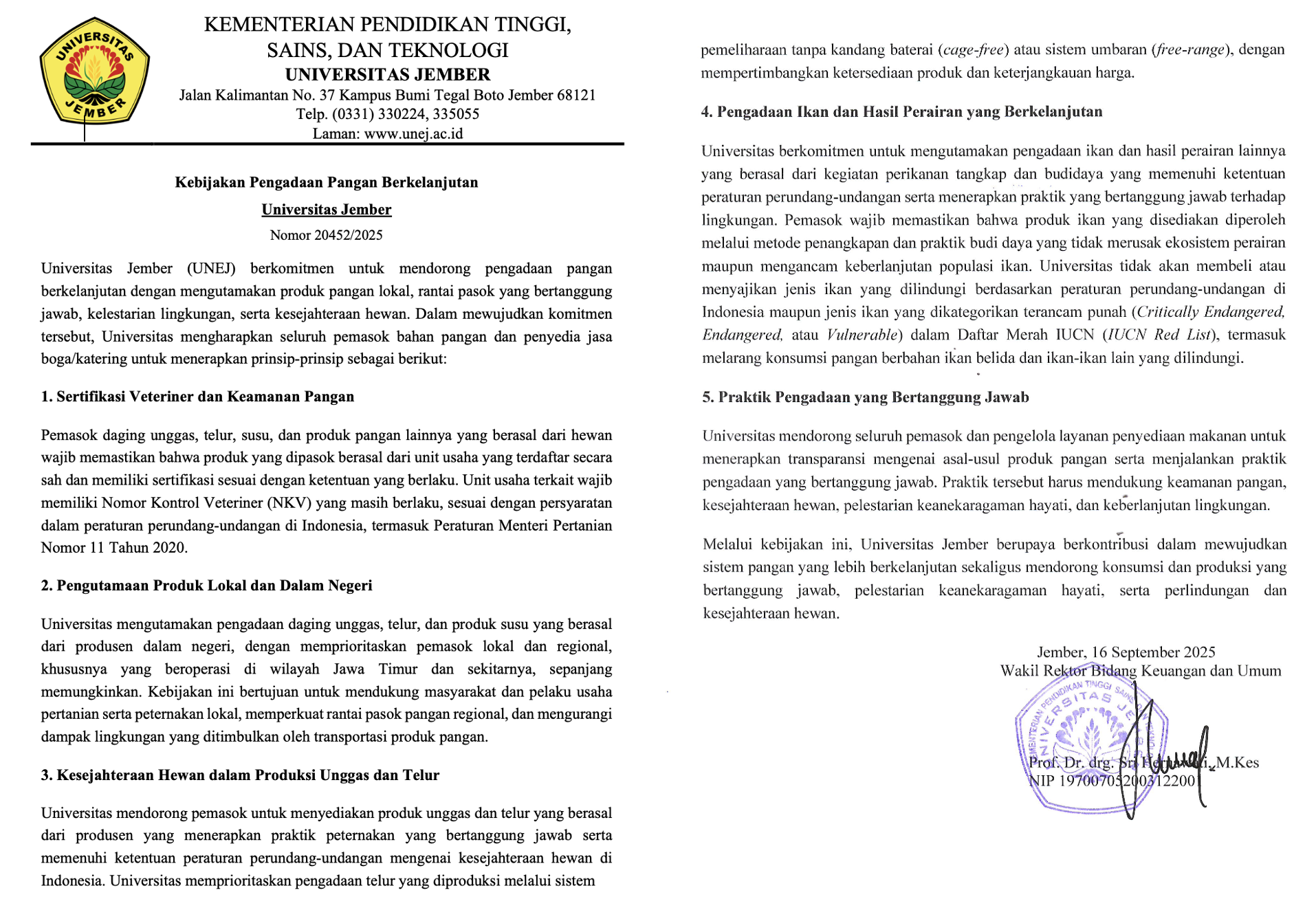
Fig. Sustainable Food Procurement Policy at UNEJ
Fateta Bakery: A University Circular That Backs a Faculty Business Unit
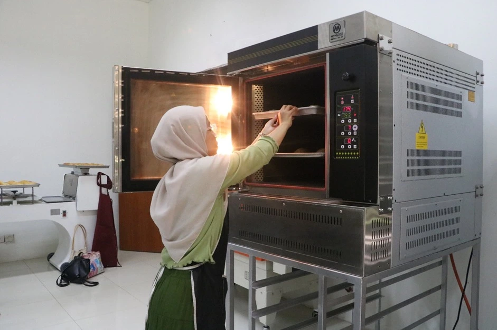
Fig. Local food production by FATETA Bakery
Universitas Jember issued a circular on buying snacks and refreshments for meetings and events (No. 4090/UN25/KP/2024, as it appears on the scan). It was signed on behalf of the Rector by the Vice Rector for Finance and General Affairs. Its goal was to make the best use of bread produced by the Faculty of Agricultural Technology (FTP) business unit and to use budgets efficiently. Every work unit must buy at least one snack item from the FTP business unit for each meeting or event.
The products made by Fateta Bakery use MOCAF (Modified Cassava Flour), a locally produced cassava flour that has undergone modification to improve its functional properties, making it comparable to wheat flour and serving as a local alternative to imported wheat flour.
News link : FATETA Bakery Unej
UNEJ Promotes Local Food Security by Serving Polo Pendem as Official Campus Snack
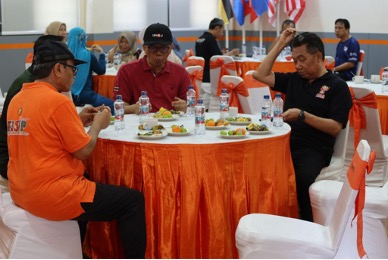
Fig. Polo Pendem: A Traditional Snack Served at Campus Events
Demonstrating its commitment to local food security and sustainable living, Universitas Jember (UNEJ) has consistently featured polo pendem, traditional local root crops such as boiled cassava, sweet potatoes, peanuts, and taro as official refreshments for campus activities, ranging from academic seminars to workshops. By replacing processed wheat-based snacks with regional agricultural produce, the university actively supports local farmers, empowers small enterprises, and promotes a fiber-rich, wholesome diet among students and faculty while fostering a warm, grounded atmosphere across its academic events.
Outlet Agro UNEJ: Opening of the UPA Taman Agroteknologi Outlet
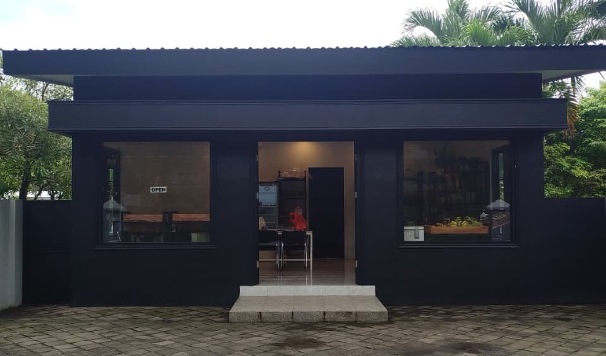
Fig. Outlet Agroteknopark
Universitas Jember (UNEJ) opened a new retail outlet, the Outlet of the UPA Taman Agroteknologi (Outlet Agro UNEJ), on 4 December 2025. The outlet sells fresh produce harvested by the UPA Taman Agroteknologi, including vegetables, fruits, and fresh juice products, so that customers can buy fresh food in a more comfortable setting.
Sources: UPA Taman Agroteknologi UNEJ, TikTok
15.2.3 Maintain and extend current ecosystems' biodiversity Vegetation
Policy During Building Construction, 10-Tree Planting Rule (2019), & Tree Felling Regulations (1 Felled : 5 Specific Trees Ratio)
To mitigate the environmental impact of physical campus expansion, Universitas Jember enforces strict regulatory mandates regarding tree preservation and land development. Under updated university infrastructure regulations, any construction project that requires felling a mature tree mandates a mandatory compensatory planting ratio of five specific native tree species for every single tree removed. This regulatory framework ensures that building development does not lead to a net loss of campus canopy cover or biodiversity degradation.
In 2025, UNEJ kept applying its compensatory policy, which builds on the 2019 rules that required students and faculties to meet tree-planting targets. When trees are removed, they can only be replaced with approved native species, which helps protect the birds and insects that live on campus. That way, any new construction is matched by real responsibility for the environment, and the campus stays green and full of life.
News Link: Universitas Jember Sumbang 19,519 Ton Oksigen Perhari — UNEJ Official | BTN and UNEJ Synergy to Realize Green Campus — UNEJ Official
UNEJ Plants 535 Trees at Jubung Agroforestry and 500 Mangroves at Tanjung Batu Beach
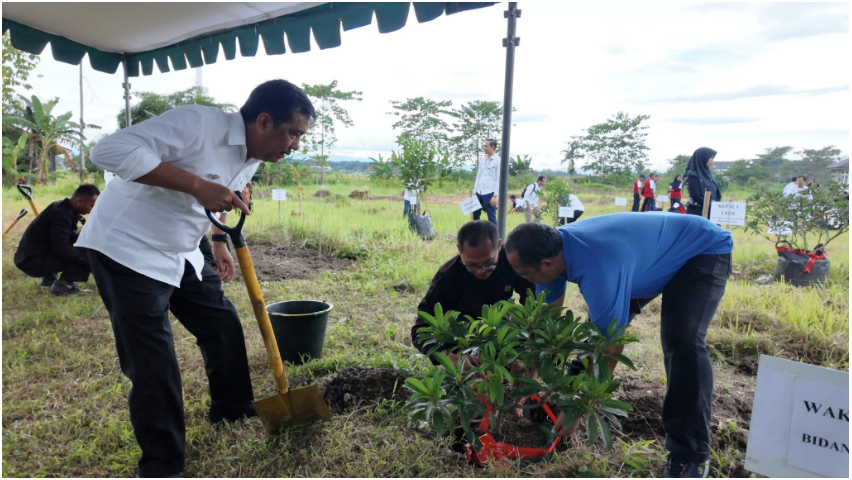
Fig. Planting Hundreds of Trees by Universitas Jember (UNEJ)
On 17 November 2025, Universitas Jember (UNEJ) held the Jubung Agroforestry event at its Jubung Vocational Campus in Jember, planting 535 trees of various productive and industrial species. The event involved the university community and several other universities in the Jember area, including UINKHAS Jember, Universitas Moch. Sroedji, and UNIPAR. These partners usually work with UNEJ on community service programs, which are part of the tridharma of higher education. The Vice Rector for Academic Affairs, Prof. Slamin, said the program supports campus sustainability and greening and will also benefit the surrounding community.
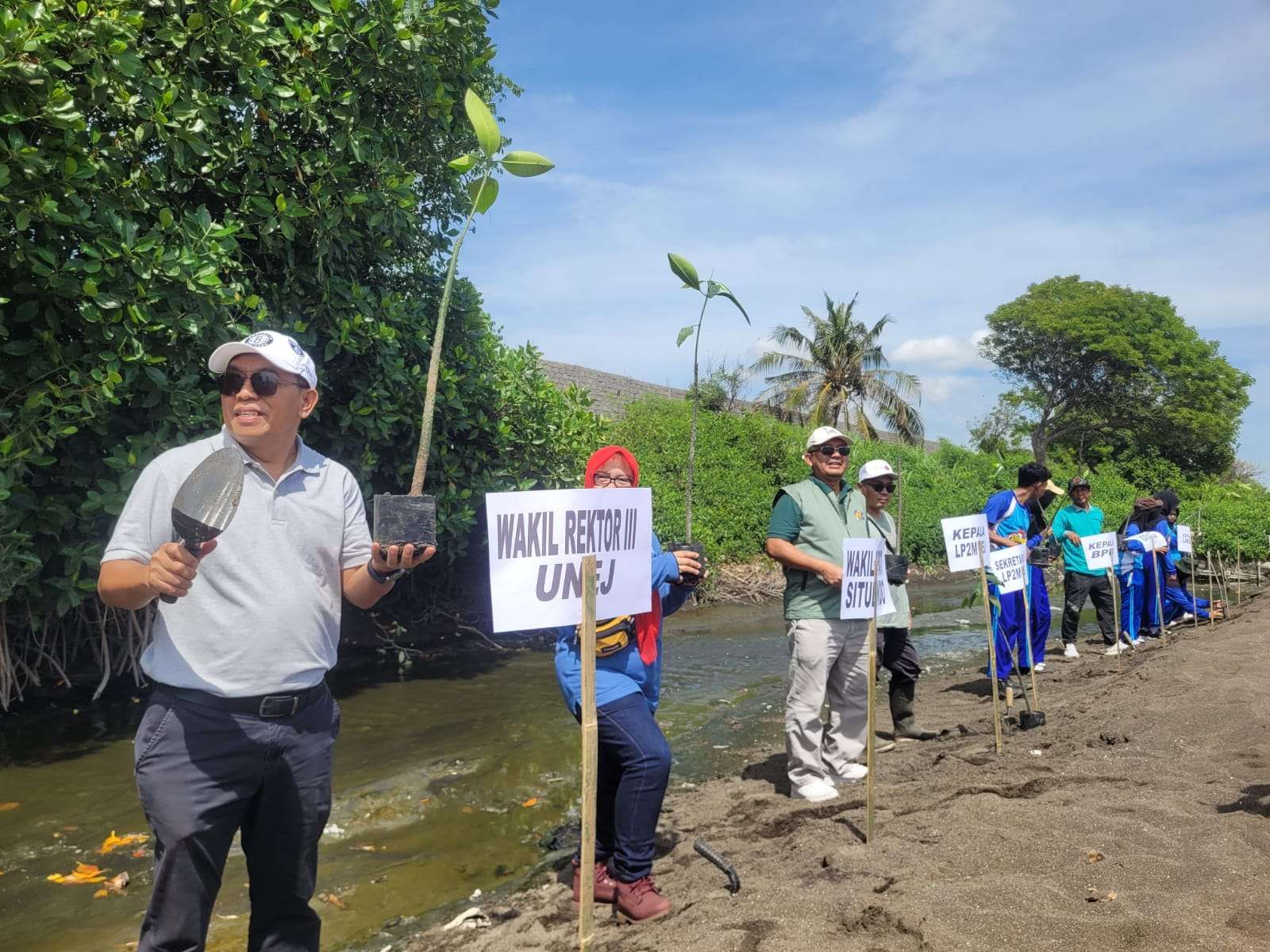
Fig. Mangrove planting at Tanjung Batu Beach
On 19 November 2025, UNEJ planted 500 mangrove trees at Tanjung Batu Beach in collaboration with the Situbondo Regency Government to address coastal erosion and disaster risks. The initiative builds on previous mangrove planting across 3,750 m². UNEJ also emphasizes community-oriented coastal conservation, ensuring that fishermen retain access to designated fishing areas to prevent conflicts over coastal land use.
News link: https://rri.co.id/jember/regional/1982788/lp2m-unej-bareng-pemkab-situbondo-tanam-500-mangrove
15.2.4 Educational programs on ecosystems
Free Educational Programs on Agrotechnopark
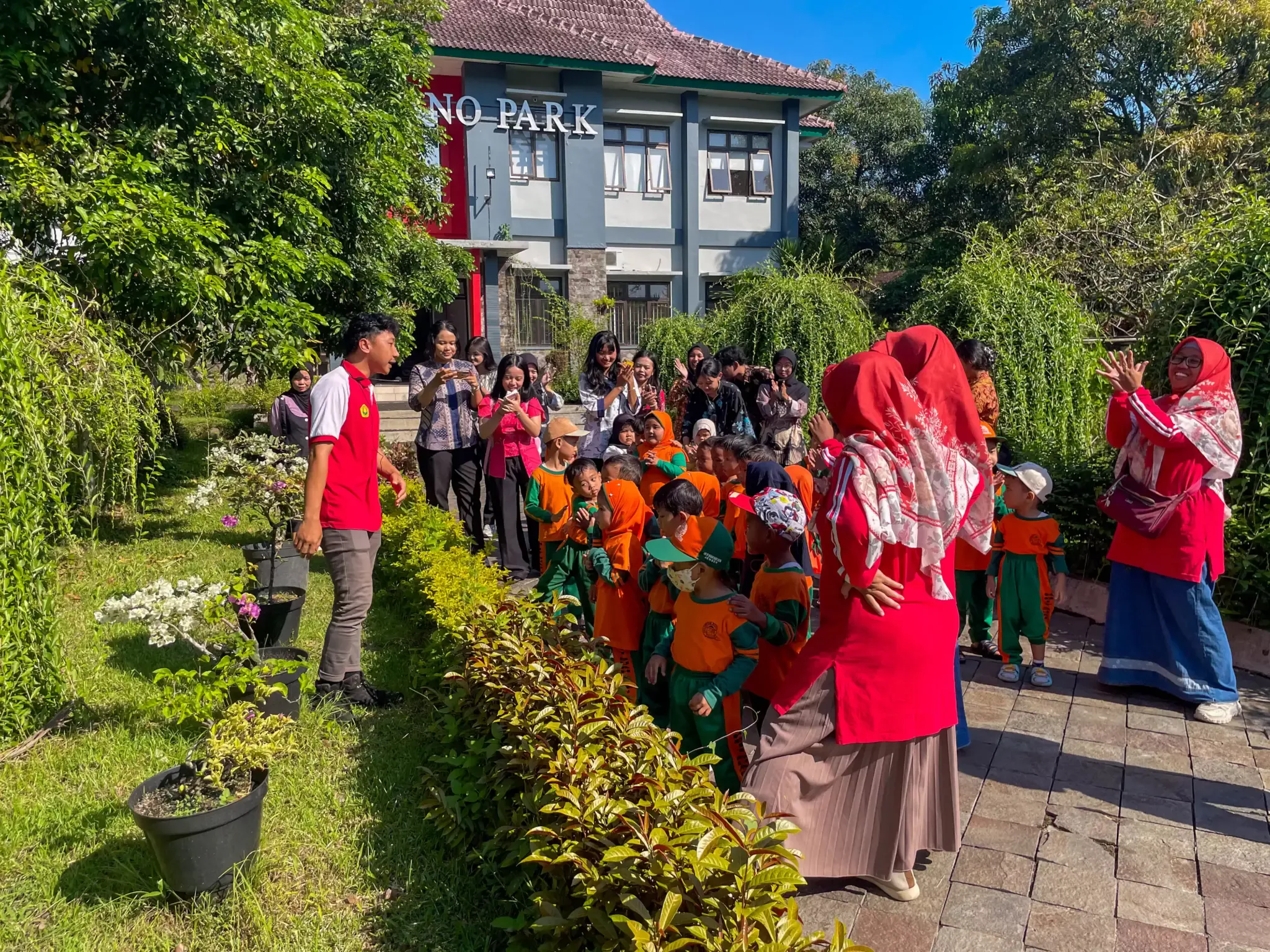
UNEJ’s Agrotechnopark provides free educational activities for visitors, from kindergarten children to university students doing internships from other institutions. It also features the Medicinal Plant Education Park (Wahana Edukasi Tanaman Obat/WETO), established in 2015, where visitors can explore the many medicinal plants found across Indonesia at no cost. In 2025, the park was still operating and open for free educational visits.
https://farmasi.unej.ac.id/blog/2015/10/28/weto-wahana-edukasi-tanaman-obat/
15.2.5 Sustainable management of land for agriculture and tourism (educational outreach)
Sustainable Agriculture Training, Organic Fertilizers, & Guest Lectures on Sustainable Farming
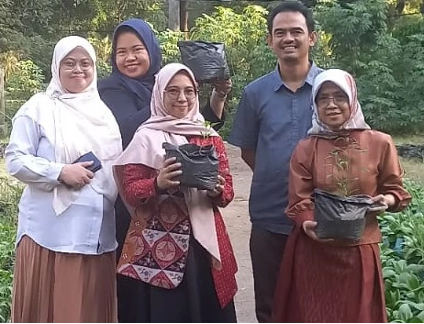
Fig. Sustainable Agriculture Training
Universitas Jember actively addresses sustainable land management by organizing national talk shows, expert seminars, and academic workshops focused on building a prosperous, eco-friendly agricultural sector. Hosting events such as the Faculty of Agriculture's talk show on "Building a Sustainable and Prosperous Agricultural Future" and research team activities (KERIS Faperta), UNEJ brings together agricultural scientists, policymakers, and local farming communities to address soil degradation, climate adaptation, and organic soil management. These educational outreach platforms emphasize replacing synthetic inputs with organic fertilizers processed from farm waste to restore long-term land fertility.
Through these academic forums and field extension programs, UNEJ transfers sustainable farming technology directly to agricultural practitioners across East Java. Faculty experts provide practical guidance on soil health management, bio-fertilizer application, and crop rotation to preserve soil integrity and boost agricultural productivity. By systematically hosting public lectures and farmer capacity-building workshops, UNEJ reinforces its institutional leadership in promoting eco-friendly agriculture and sustainable land stewardship.
15.2.6 Tourism Outreach: Teduh Glamping, Ijen Geopark
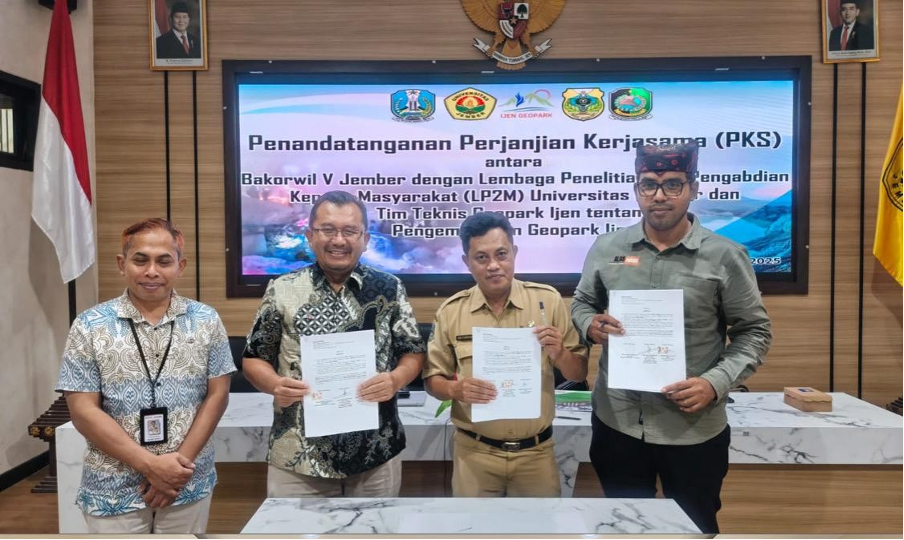
Fig. Signing of a Memorandum of Understanding (MoU) between Universitas Jember (UNEJ), Regional Coordination Agency V (Bakorwil V), and Ijen National Geopark .
Universitas Jember establishes strategic partnerships with regional authorities to promote sustainable ecotourism and land management, most notably through formal collaborations between Bakorwil V (Regional Coordination Agency), LPPM UNEJ, and the Ijen Geopark management team. Through these academic partnerships, UNEJ researchers conduct comprehensive botanical and ecological surveys across the UNESCO Global Geopark territory, assessing local plant diversity and geological conservation zones. This scientific data directly informs sustainable tourism frameworks that protect fragile terrestrial ecosystems from tourist overuse while boosting local economic development.
Beyond ecological assessments, UNEJ faculty and student researchers provide technical consultancy for sustainable eco-glamping setups like Teduh Glamping, ensuring that tourism infrastructure development adheres to strict land conservation principles. The university promotes organic waste composting and eco-friendly land management across ecotourism sites to maintain soil quality and prevent pollution. Through these multi-stakeholder collaborations, UNEJ proves its structural commitment to balancing regional economic growth through ecotourism with rigorous ecological conservation. On 9 February 2025, Ten students promoted the Galeri Raung program at Teduh Glamping, introducing it as an information center and educational tourism destination.
15.3.1 Sustainable use, conservation and restoration of land (policy)
Green Campus Sustainability Policy (SPMI), Supporting Invertebrates & Rare Plants (Dehaasia pugerensis, Cyathea)
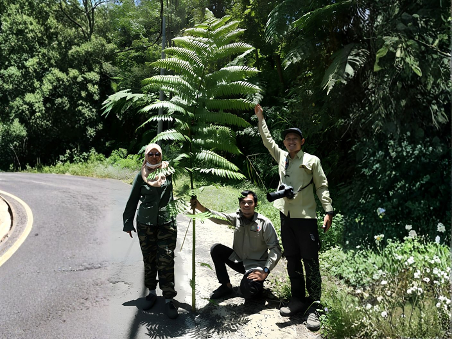
Fig. Ancient Plant Species in the Ijen Geopark Area
Universitas Jember embeds land sustainability and biodiversity protection directly into its institutional Quality Assurance System (SPMI) under Green Campus operational guidelines. These formal policies govern land-use practices across campus grounds, ensuring that environmental protection is a mandatory criterion for administrative and physical operations. The framework mandates active conservation efforts for native flora and fauna, establishing protected green corridors and dedicated ecological management zones across the university.
Operated under UPA Agroteknopark and the Biology Department, targeted biological preservation projects focus on maintaining habitats for native bee pollinators essential for local plant reproduction and crop health. Simultaneously, university botanists manage dedicated cultivation programs to protect rare and endangered indigenous plant species, such as Dehaasia pugerensis, Cyathea contaminans, and Cyathea orientalis (ancient ferns in the Ijen Geopark area). By systematically integrating native pollinator support and endangered plant conservation into campus policy, UNEJ maintains a high standard of land stewardship and biological preservation.
News Link: Peneliti UNEJ Ungkap Tanaman Purba di Kawasan Geopark Ijen — Good News From Indonesia | Konservasi Dehaasia pugerensis — YouTube UNEJ
Universitas Jember Establishes "Bee Friends" Program to Drive Environmental Education and Community Entrepreneurship
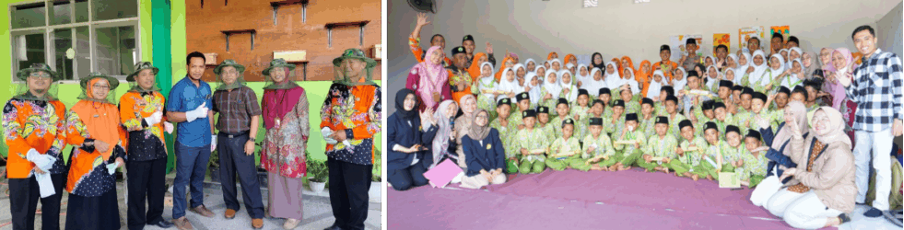
Fig. Bee Friends Environmental Education and Community Entrepreneurship
Universitas Jember (UNEJ) has formally established "Bee Friends," an innovative community outreach and educational initiative led by its Biology Education team from the Faculty of Teacher Training and Education (FKIP). Designed to translate academic research into tangible ecological and economic benefits, the program utilizes stingless bee (lebah klanceng) cultivation to promote environmental sustainability, nature-based learning, and early-stage entrepreneurship. By integrating hands-on workshops into primary education, developing dedicated teaching units like "Ekosistem dalam Harmoni" for educators, and training local communities in honey harvesting, UNEJ actively aligns its outreach with national Kurikulum Merdeka standards (P5 and PPRA). Ultimately, this program reinforces UNEJ's 2021-2025 Master Plan for Research and Community Service (RIPP) in the fields of food security, industrial agriculture, and environmental stewardship, solidifying the university's role as a civic anchor driving sustainable regional development.
15.3.2 Monitoring IUCN and other conservation species (policies)
UNEJ botanist (Prof. Hari Sulistiyowati, Ph.D) manage dedicated cultivation programs to protect rare and endangered indigenous plant species, such as Dehaasia pugerensis, Cyathea contaminans, and Cyathea orientalis (ancient ferns in the Ijen Geopark area). By systematically integrating native pollinator support and endangered plant conservation into campus policy, UNEJ maintains a high standard of land stewardship and biological preservation. Dehaasia pugerensis is an endemic tree found only in Jember Regency, East Java. This species is listed on IUCN 2022: T37409A138507783 and assessed as Critically Endangered with only 191 species left.
News Link: https://www.iucnredlist.org/species/37409/138507783
The botanist profile: https://sinta.kemdiktisaintek.go.id/authors/profile/6009136
15.3.3 Local biodiversity included in planning and development
Universitas Jember (UNEJ) includes green space and biodiversity in its planning and development through its Green Campus Standard, issued under Rector’s Decree No. 9026/UN25/KP/2018 and revised in 2019. The Sustainable Land Use Standard (GC-01, 7 December 2019) requires the university to keep an infrastructure document that is updated every year as the basis for planning and development. It makes the university leadership, the deans, and the heads of work units responsible for increasing vegetated areas. It sets minimum targets for the main campus: at least 35% covered by forest-type vegetation (areas mostly covered by large trees and biodiversity for conservation purposes), at least 40% by planted vegetation and gardens, at least 30% for water absorption, and at least 70 m² of open space per campus member. For construction, the Green Building Standard (GC-03) requires UNEJ’s development and renovation policies to include at least four green building elements, assessed against the Greenship Existing Building standard and reviewed with an annual recommendation document.
For tree felling, UNEJ applies a rule against cutting down trees, as stated publicly by its Vice Rector II in 2019. When land is needed for a new building, trees must be relocated and replanted elsewhere on campus. Where felling cannot be avoided, a compensation planting rule applies, currently five new trees for each tree felled, with the plant species decided by the campus, which in practice are local plants. UNEJ also designs its buildings vertically to save land, so less vegetation is cleared. The rule is still enforced today. In 2019, UNEJ’s green open space covered 34.96% of its 87-hectare main campus, which holds 9,905 mature trees, and the university evaluates its vegetation and campus bird numbers every year and adds vegetation, including rare species.
Sources: Green Campus Standard of Universitas Jember (GC-01 and GC-03, revised 2019) | UNEJ, 20 Nov 2019
15.3.4 Alien species impact reduction (policies)
Universitas Jember (UNEJ) is committed to protecting local ecosystems and managing alien species through binding institutional policies, strategic campus planning, and academic leadership.
Institutional Policy and Tree Replacement Ratio. Under the Rector’s Decree No. 9026/UN25/KP/2018 on Green Campus Guidelines (reviewed and updated in 2019), UNEJ enforces a strict vegetation management directive. Specifically, the policy mandates a 1:4 to 1:5 replacement ratio requiring the planting of four to five carefully selected native or non-invasive trees for every single tree removed due to infrastructure development or safety reasons. This policy serves a dual purpose: it significantly increases campus biomass density and actively suppresses the proliferation of invasive alien plant species by occupying ecological niches with robust, controlled flora.
Academic Leadership and Integrated Approaches. UNEJ integrates its operational species management into its academic and research agenda. On July 29-30, 2025, the university hosted a International Seminar featuring plant protection experts to address invasive species control and biosecurity challenges. A central highlight of the conference was the development of an integrated approach combining strengthened plant quarantine systems, early detection mechanisms, and biological controls to mitigate the impact of alien species across campus and surrounding ecosystems.
News Link: https://unej.ac.id/blog/2025/07/29/pakar-proteksi-tanaman-se-indonesia-berkumpul-di-kampus-unej/
15.3.5 Collaboration for shared land ecosystems
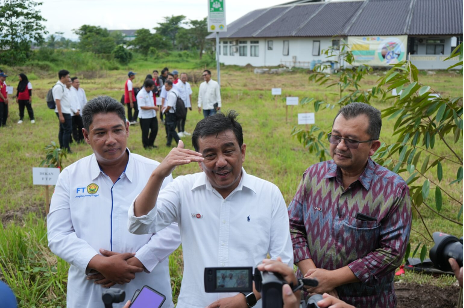
Fig. Collaborative Tree-Planting Initiative among Institutions
Universitas Jember (UNEJ) works with other universities, community groups, and residents to maintain shared land ecosystems through tree planting and community service. On 17 November 2025, UNEJ planted 535 productive and industrial trees at its Jubung Vocational Campus in the Jubung Agroforestry activity, which involved the academic community and other universities in Jember, including UINKHAS Jember, Universitas Moch. Sroedji, and UNIPAR, through UNEJ’s community service programs.
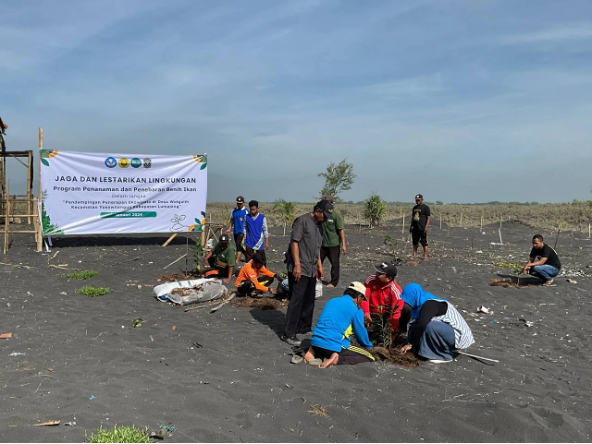
FIg. Tree-Planting Activities in Tourism Areas
UNEJ also works with local community groups. Its Institute for Research and Community Service (LPPM) partnered with the tourism awareness group (Kelompok Sadar Wisata, Pokdarwis) of Wotgalih Village in Lumajang, where a village assistance team led by a lecturer of the Faculty of Mathematics and Natural Sciences planted 600 trees and released 14,000 fish seeds at the coast in January 2024 as part of assisting the village’s ecotourism. In August 2025, students of UNEJ’s community service program (KKN UMD) in Karangharjo Village, Banyuwangi, worked with residents of Sidodadi hamlet to turn unused green space near housing into a community garden of medicinal and food plants, after a land survey and discussion with the hamlet head on 26 July 2025, with residents taking part from land preparation to planting and maintenance.
In collaboration with Situbondo Regency Government, On 19 November 2025 UNEJ planted 500 mangrove trees at Tanjung Batu Beach to address coastal erosion and disaster risks. The initiative builds on previous mangrove planting across 3,750 m². UNEJ also emphasizes community-oriented coastal conservation, ensuring that fishermen retain access to designated fishing areas to prevent conflicts over coastal land use.
Sources: UNEJ, 18 Nov 2025 | UNEJ, 12 Jan 2024 | Kompasiana, 3 Aug 2025 (KKN UMD UNEJ Karangharjo)
https://rri.co.id/jember/regional/1982788/lp2m-unej-bareng-pemkab-situbondo-tanam-500-mangrove
15.4.1 Water discharge guidelines and standards
Universitas Jember (UNEJ) manages liquid waste under its Green Campus Standard, which was established by Rector’s Decree No. 9026/UN25/KP/2018 as a reference for environmental management at the university. The waste handling standard (GC-06, 7 December 2019) requires the university leadership to run a liquid waste disposal program, makes the Environment and Disaster Center of LP2M responsible for auditing it, and sets as an indicator that liquid waste is handled technically, for down-cycling or up-cycling. The water resource management standard (GC-07) adds requirements for water conservation, water recycling, and the use of treated water, which LP2M plans, evaluates, and audits. In practice, non-hazardous liquid waste from laboratories and buildings such as the IsDB building is handled following an operating procedure that the units apply. Hazardous liquid waste is handled separately through the hazardous waste process described in 15.4.3.
Sources: Rector’s Decree No. 9026/UN25/KP/2018 | Green Campus Standard of Universitas Jember (GC-06)
15.4.2 Policy on plastic waste reduction
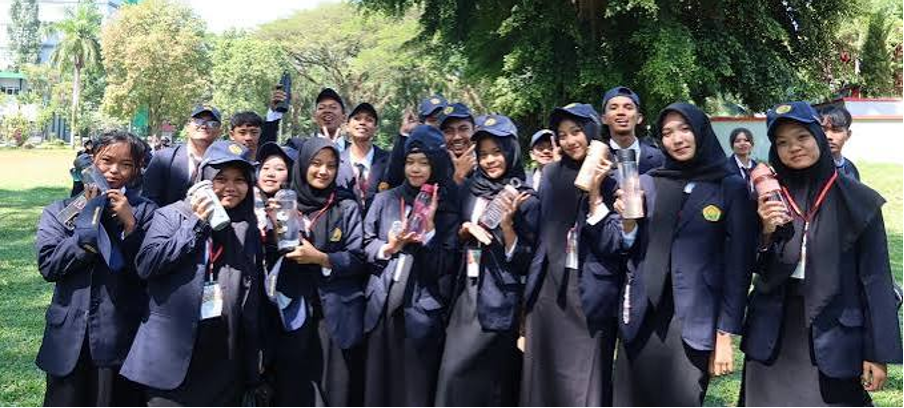
Fig. Students Use Reusable Tumblers to Refill Their Drinking Water Throughout Campus Activities.
Universitas Jember (UNEJ) continues to run a plastic reduction program, mainly by reducing the use of plastic on campus. This follows its Green Campus Standard, established by Rector’s Decree No. 9026/UN25/KP/2018. The waste handling standard (GC-06) requires the university leadership to run a campus program to reduce paper and plastic use, and it makes LP2M responsible for auditing that program. For its 2025 new student orientation (PKKMB), the committee requires new students to bring their own tumblers and food containers without styrofoam. A similar measure was applied since August 2024, when participants of the ARUNA UNEJ activity brought their own drinking bottles.
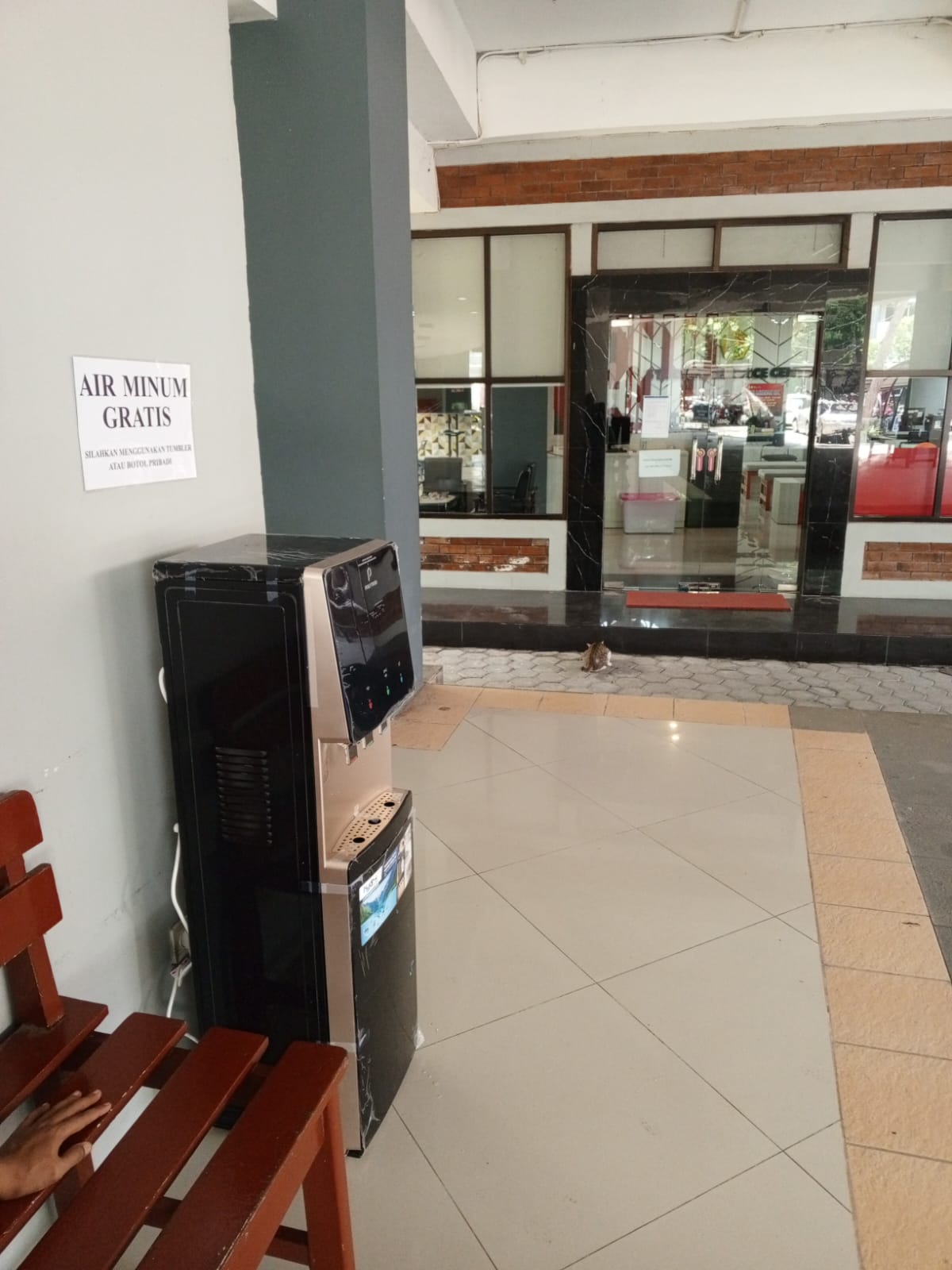
Refill drinking water is available at dispensers on campus. UNEJ’s online administration system reduces paper documents and may also indirectly reduce the use of plastic stationery.
Sources: Rector’s Decree No. 9026/UN25/KP/2018 | Green Campus Standard of Universitas Jember (GC-06) | UNEJ, 19 Aug 2024 (ARUNA)
15.4.3 Policy on hazardous waste disposal
Universitas Jember (UNEJ) handles hazardous waste under its Green Campus Standard, established by Rector’s Decree No. 9026/UN25/KP/2018 (which is further translated into the Standard Operating Procedure (SOP) for Waste Transportation within the Universitas Jember Environment, which was revised in January 2025). The waste handling standard (GC-06) requires the university to guarantee the handling of all toxic waste, makes LPPM responsible for auditing it, and sets as an indicator that more than 75% of hazardous (B3) waste is handled in cooperation with third parties. A main source is the UNEJ Dental and Oral Hospital (RSGM), whose medical waste is classed as B3 waste. Medical waste is sorted at source into medical and non-medical bins, sharps go into safety boxes, waste bags are removed daily or when two-thirds full, cytotoxic waste is kept in strong leak-proof containers, and all waste from operating rooms is treated as infectious. Waste is taken to the hospital’s hazardous waste storage, weighed daily, and recorded in a manifest book. The transporter PT Wastec collects it twice a week, and its workers wear protective equipment. This follows Ministry of Environment and Forestry Regulation No. 56 of 2015 on managing hazardous waste from health facilities.
Sources: Rector’s Decree No. 9026/UN25/KP/2018 | Green Campus Standard of Universitas Jember (GC-06) |