
SDG 13 Universitas Jember 2025
SDG 13 Evidence News: Climate Action
SDG 13 · Indicator 13.2.1 · Low carbon energy tracking
UNEJ Records Solar Power Output at Four Sites Every Month
Low-carbon energy tracking covers the whole university, from 91 PLN electricity meters to the campus solar power systems.
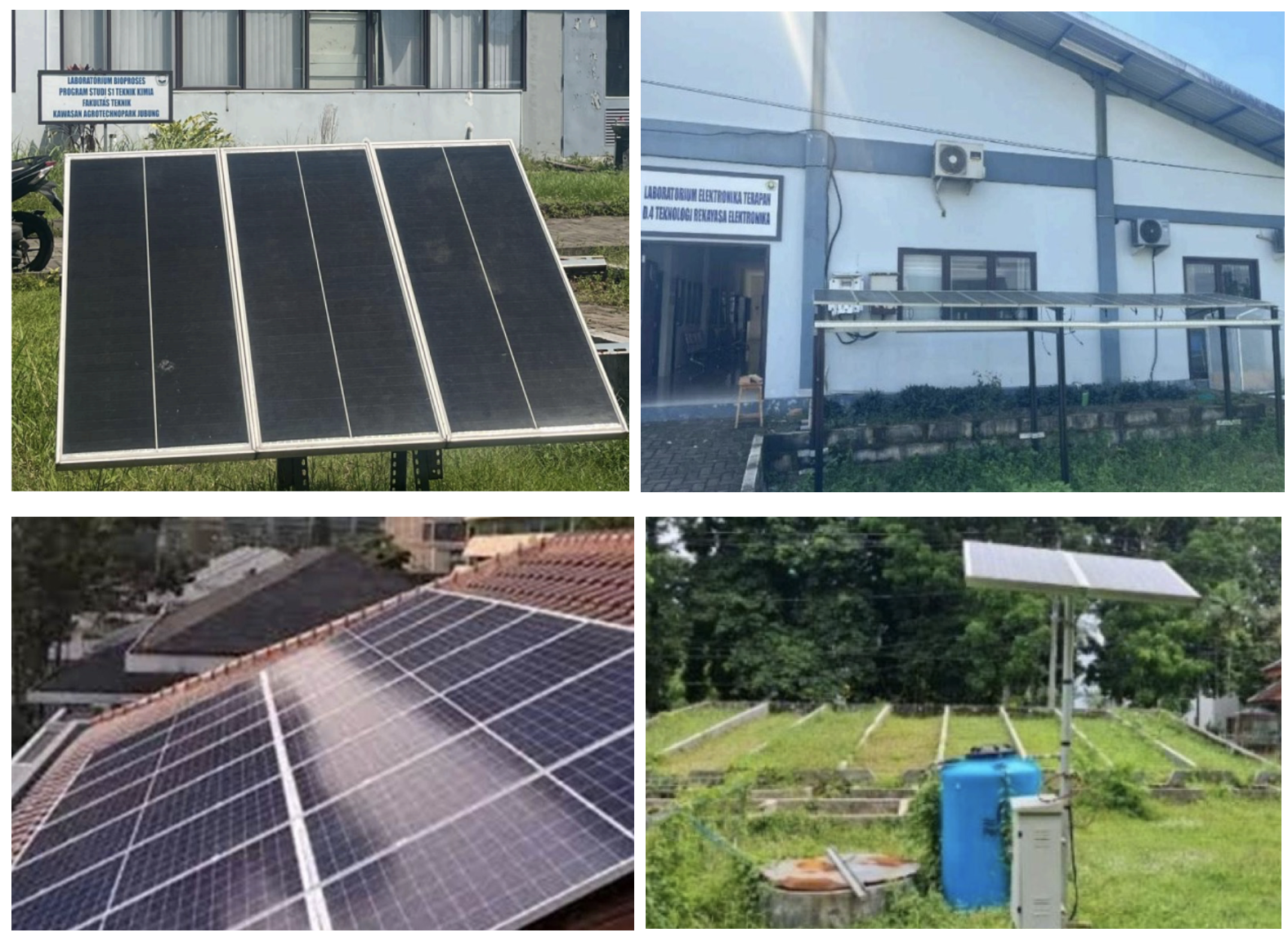
JEMBER – Universitas Jember (UNEJ) measures the amount of low-carbon energy used across the whole university. Its low-carbon energy currently comes from solar photovoltaic (PV) systems installed at four sites: the Jubung Agrotechnopark, the Faculty of Engineering, and the rooftops of the CDAST building and the Rectorate.
This measurement is required by the Energy Use Efficiency Standard (GC-05) of the UNEJ Green Campus Standards (Rector's Decree No. 9026/UN25/KP/2018). The standard requires university leaders to record electricity use every year and requires the Institute for Research and Community Service (LP2M) to calculate the total renewable energy produced and its ratio to total energy consumption.
The output of each PV system is recorded from the kWh meter on its inverter. Staff read and record the meters every month and compile the readings into annual output in kilowatt-hours and gigajoules (1 kWh = 0.0036 GJ). For comparison, the university's total energy consumption is calculated from itemised PLN bills for all 91 utility meters on the Tegalboto, Jubung, Bondowoso, Lumajang and Pasuruan campuses, together with fuel data for official vehicles from the UNEJ Sustainability Report. Measurement therefore covers the whole university.
In 2025, the campus PV systems generated 6,146 kWh, or 22.1 GJ. Electricity from the PLN grid is not counted as low-carbon energy because UNEJ does not hold renewable energy certificates.
Inventory of low-carbon energy systems and their recording, 2025
Site | Capacity (kWp) | 2025 output (kWh) | Recording method | Frequency |
Jubung Agrotechnopark | 30 | 2,800 | kWh meter on inverter | Monthly |
Faculty of Engineering | 10 | 1,346 | kWh meter on inverter | Monthly |
CDAST building rooftop | 20 | 1,500 | kWh meter on inverter | Monthly |
Rectorate rooftop | 5 | 500 | kWh meter on inverter | Monthly |
Total | 65 | 6,146 |
|
|
Supporting documents
▪ UNEJ Green Campus Standards: GC-05 Energy Use Efficiency Standard
SDG 13 · Indicator 13.2.2 · Low-carbon energy use
UNEJ Used 22.1 GJ of Low-Carbon Energy out of 40,771.7 GJ in 2025
Campus solar power supplied 0.05% of all energy used by the university.
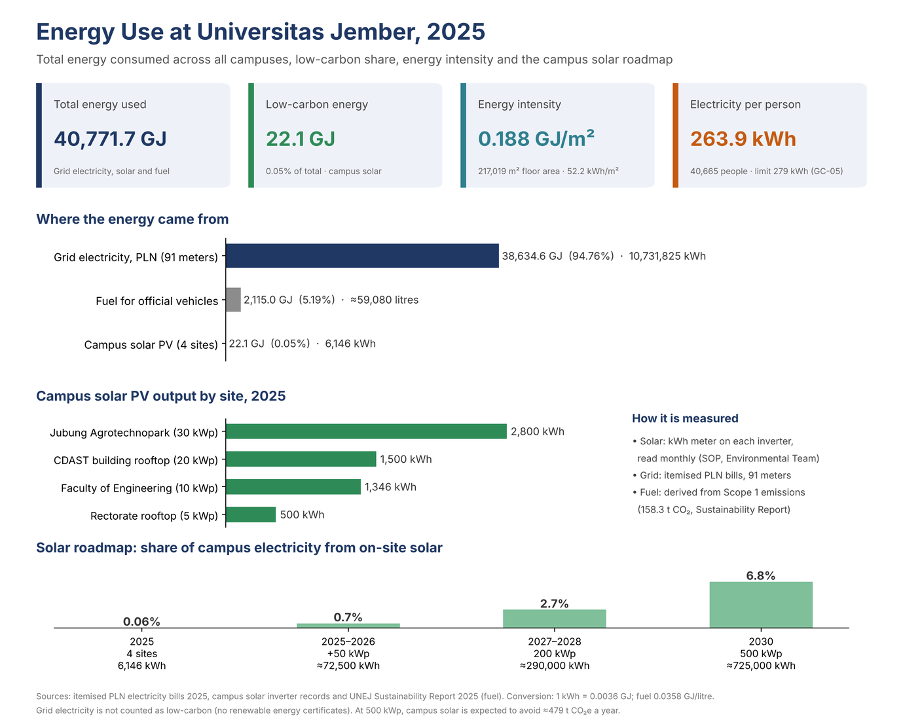
JEMBER – Universitas Jember (UNEJ) used 40,771.7 gigajoules (GJ) of energy in 2025. Of this, 22.1 GJ, or 0.05%, came from low-carbon sources, all of it from the campus solar PV systems.
The largest source was PLN grid electricity of 10,731,825 kWh, based on the itemised 2025 bills for 91 utility meters, equal to 38,634.6 GJ. Fuel for official vehicles amounted to about 59,080 litres, equal to 2,115.0 GJ; this volume was derived from the Scope 1 emissions of 158.3 tonnes of CO₂ in the UNEJ Sustainability Report 2025, using a factor of 2.68 kg of CO₂ per litre of diesel. The PV systems at four sites generated 6,146 kWh, or 22.1 GJ.
PLN grid electricity is not counted as low-carbon energy because it is not covered by renewable energy certificates, and fossil fuels are also excluded. These figures are the same as those reported for SDG indicators 7.3.1 and 7.5.1.
To increase the share of low-carbon energy, UNEJ has drawn up a solar expansion roadmap: an additional 50 kWp in 2025–2026, 200 kWp in 2027–2028 and 500 kWp by 2030. At 500 kWp, the campus PV systems are expected to generate about 725,000 kWh a year, or 6.8% of current electricity consumption.
UNEJ total and low-carbon energy use, 2025
Energy source | Quantity | Energy (GJ) |
PLN grid electricity | 10,731,825 kWh | 38,634.6 |
Campus solar PV (4 sites) | 6,146 kWh | 22.1 |
Fuel for official vehicles | ±59,080 litres | 2,115.0 |
Total energy |
| 40,771.7 |
Low-carbon energy |
| 22.1 (0.05%) |
Conversion factors: electricity 0.0036 GJ/kWh; fuel 0.0358 GJ/litre (diesel).
Supporting documents
SDG 13 · Indicator 13.3.1 · Local education programmes on climate
From Primary School Comics to a Climate Conference, UNEJ Educates Communities about Climate Change
Throughout 2025, UNEJ reached pupils, farmers, coastal residents and village governments with education on climate risks, mitigation and adaptation.
JEMBER – Universitas Jember (UNEJ) ran climate change education programmes for local communities throughout 2025, covering the risks and impacts of climate change, mitigation, adaptation and the use of climate information.
On 10 February 2025, UNEJ's Faculty of Public Health and Universiti Malaysia Sabah taught climate change to 108 pupils in Grades 4 to 6 at SDN Lojejer 1, Wuluhan District, Jember. The lessons used illustrated comics, storytelling and drawing to help the children understand the effects of climate change around them.
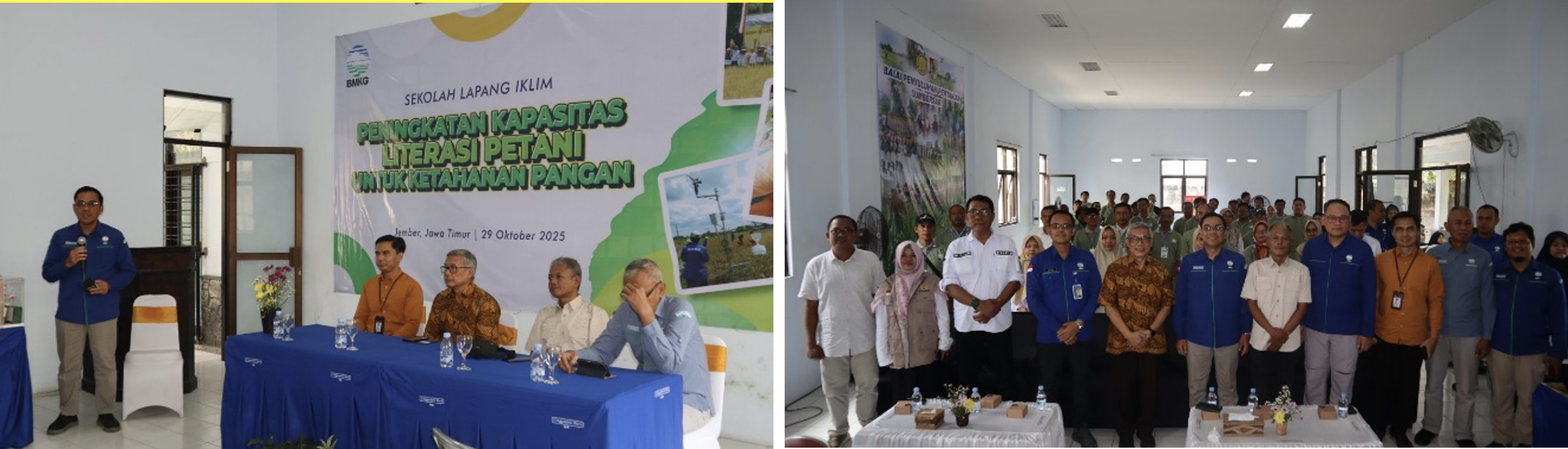
Farmers were also reached. On 29 October 2025, UNEJ experts introduced digital farming technologies at the Climate Field School organised by the Indonesian Agency for Meteorology, Climatology and Geophysics (BMKG) at the Sumbersari Agricultural Extension Centre. The school trained farmers to read climate information to plan their planting.
In November 2025, LP2M's Centre for Environment and Disaster Studies held the UNEJ Climate Change Conference (UNEJ-C3), which was open to the public and streamed online, on ecosystem-based adaptation and climate-resilient villages. In the same month, UNEJ and the Situbondo Regency Government planted 500 mangrove seedlings at Tanjung Batu Beach, Landangan Village, an area prone to coastal erosion and tidal flooding, and ran mangrove education for local pupils.
Mitigation education also took place in villages through renewable energy projects built with residents. In 2025, UNEJ built five renewable energy facilities in four regencies, and at SMKN 1 Sempol, Bondowoso, the installation of a micro solar system was accompanied by renewable energy outreach for pupils and teachers.
UNEJ climate education programmes for the community, 2025
Date | Activity | Audience | UNEJ's role |
10 Feb 2025 | Climate change education through comics, SDN Lojejer 1, Wuluhan | Pupils in Grades 4–6 | Organiser (Faculty of Public Health) with Universiti Malaysia Sabah |
29 Oct 2025 | Climate Field School, Sumbersari Agricultural Extension Centre | Farmers | Expert resource |
Nov 2025 | UNEJ Climate Change Conference (UNEJ-C3) | Government, academics, the public | Organiser (LP2M Centre for Environment and Disaster Studies) |
Nov 2025 | Planting of 500 mangroves and education, Tanjung Batu Beach, Situbondo | Pupils and coastal residents | Co-organiser with the Situbondo Regency Government |
2025 | Renewable energy outreach and micro solar system, SMKN 1 Sempol | Pupils and teachers | Organiser (community service grant) |
Supporting documents
▪ UNEJ Faculty of Public Health partners with Universiti Malaysia Sabah on climate change education
▪ Director General for Disadvantaged Regions encourages UNEJ to study climate-resilient villages
SDG 13 · Indicator 13.3.2 · Climate Action Plan, shared
UNEJ Climate Action Plan: Four Pillars towards Net Zero Emissions by 2060
The university's climate action plan sets out an emissions baseline, targets, programmes and monitoring, and is shared with government and communities.
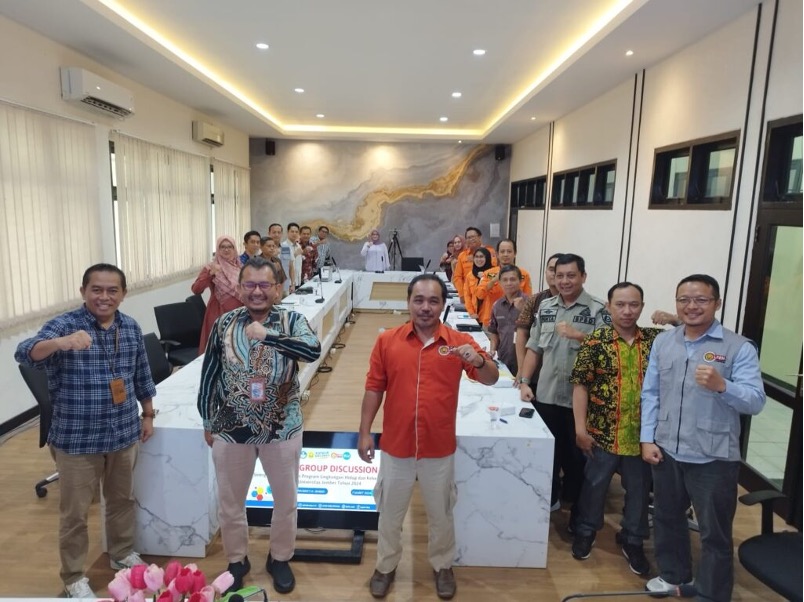
JEMBER – Universitas Jember (UNEJ) has a climate action plan to measure, plan and reduce campus greenhouse gas emissions. Its direction and target are set out in the Universitas Jember Commitment Letter Towards Zero Emission No. 13793/UN25/TU/2025, signed by the Rector on 30 June 2025, which sets a target of net zero emissions by 2060. The actions are set out in four environmental strategy pillars in the UNEJ Social, Economic and Environmental Impact Report 2025.
The plan rests on regular measurement. Every year, LP2M calculates the campus carbon footprint under the Carbon Emission Reduction Standard (GC-04) of the Green Campus Standards, which sets a target of less than 0.1 tonnes of CO₂e per person. The 2025 greenhouse gas inventory was prepared under the GHG Protocol Corporate Standard. Scope 1 and 2 emissions were 7,241 tonnes of CO₂e, comprising 7,083 tonnes of Scope 2 emissions from PLN electricity and 158 tonnes of Scope 1 emissions from fuel for official vehicles. Scope 3 emissions, covering business travel, student transport, paper and waste, were 10,004 tonnes of CO₂e. The 2025 figures serve as the baseline for tracking emission reductions in the coming years.
The first pillar, climate change mitigation, is the core of the plan. Its measures include energy efficiency (LED lighting in all buildings, inverter air conditioning and key-card switches in dormitories), solar expansion to 500 kWp by 2030, protection of 50.54 hectares of campus forest and low-carbon mobility. The other three pillars cover water conservation, biodiversity protection, and the circular economy and waste management. Each pillar has short-, medium- and long-term targets with indicators.
The plan is shared with government and communities. The 2025 Impact Report, which contains the four pillars, was prepared under Ministerial Decree No. 361/M/KEP/2025, submitted to the Ministry of Higher Education, Science and Technology and published openly. In November 2025, the plan was presented to residents and the Climate Village (ProKlim) group of Suci Village together with Ecoton. This built on a forum held by LP2M's Centre for Environment and Disaster Studies on 7 March 2024, which brought together the planning, environment and disaster management agencies of Jember, Lumajang, Bondowoso and Situbondo regencies to align environmental and disaster programmes, including community-based climate adaptation.
Summary of the UNEJ climate action plan
Pillar | Main programmes | Target | Basis |
Climate change mitigation | LED lighting, inverter air conditioning, key-card switches, 500 kWp solar PV (2030), 50.54 ha campus forest, low-carbon mobility | Net zero by 2060; carbon footprint <0.1 t CO₂e per person | Commitment Letter 13793/UN25/TU/2025; GC-04, GC-05 |
Water conservation | Biopore holes, infiltration wells, sensor taps, wastewater treatment | Flood-safe campus | Impact Report 2025 |
Biodiversity | Care of 9,905 trees, habitat protection for 40 bird species | 70% green open space | Impact Report 2025 |
Circular economy and waste | Compost 350 t, recycling 22.6 t, hazardous waste 7.65 t | 100% of waste managed | Impact Report 2025 |
Monitoring | Annual GHG inventory (GHG Protocol); 2025 baseline: Scope 1+2 7,241 t, Scope 3 10,004 t CO₂e | Annual report | GC-04; LP2M |
Supporting documents
▪ Universitas Jember Commitment Letter Towards Zero Emission (Rector, 30 June 2025)
SDG 13 · Indicator 13.3.3 · Co-operative planning for climate change disasters
UNEJ and Government Plan Together for Climate Disasters
The cooperation spans BPBD Jember, four regencies in the Tapal Kuda region, the Situbondo Regency Government and support for flood evacuees in Aceh Tamiang.
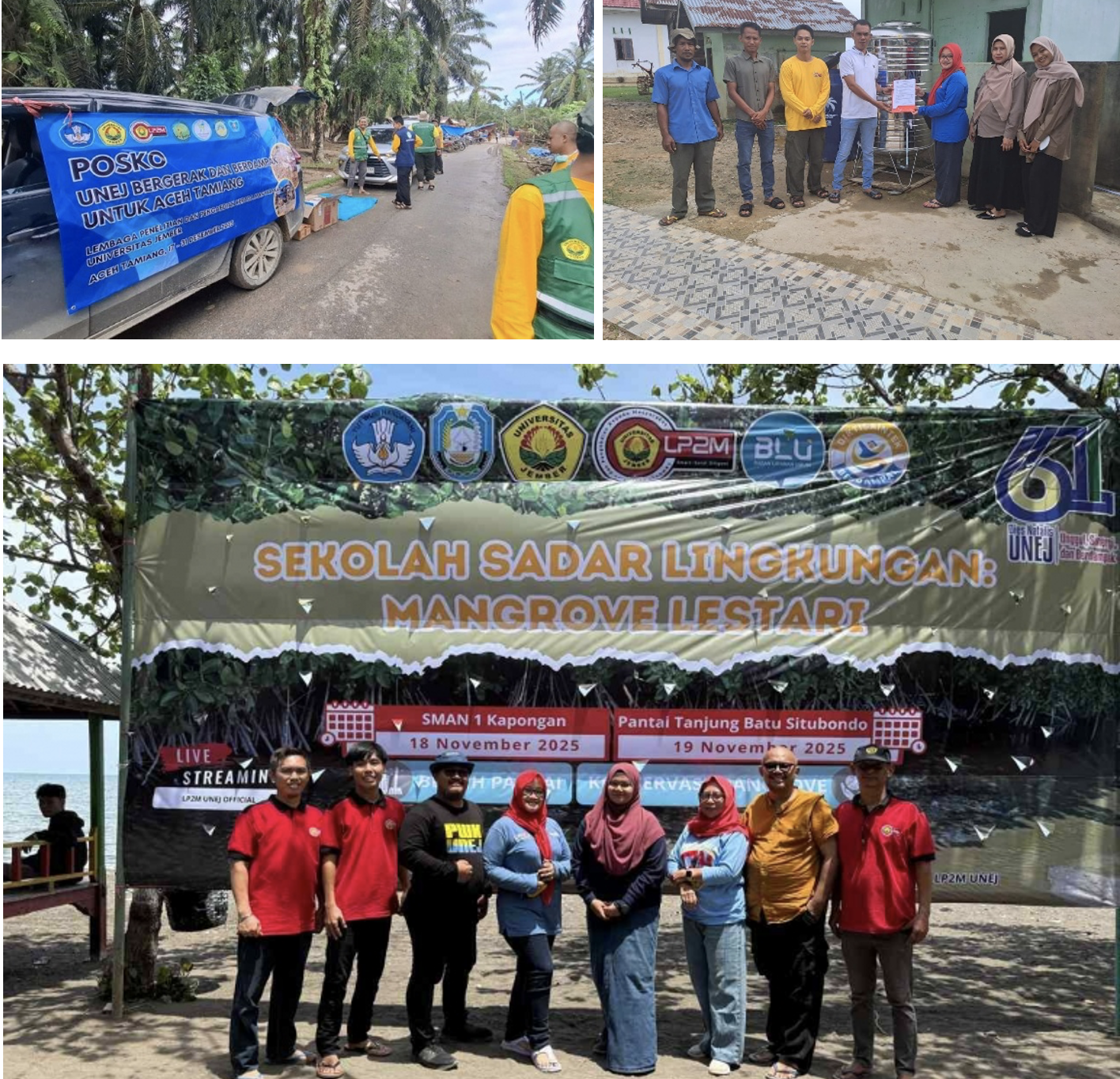
JEMBER – Universitas Jember (UNEJ) takes part in planning for climate-related disasters with government at local and regional levels. UNEJ established the Centre for Environment and Disaster Studies within LP2M because Jember and the surrounding area are prone to floods, landslides, whirlwinds, droughts and coastal erosion.
At the local level, UNEJ's Faculty of Engineering signed a cooperation agreement with the Jember Regional Disaster Management Agency (BPBD) on 24 March 2022, covering early warning systems, disaster education and the use of university expertise in disaster response. At the regional level, on 7 March 2024, LP2M brought together the planning, environment and disaster management agencies of Jember, Lumajang, Bondowoso and Situbondo regencies to align the planning of environmental and disaster programmes.
This joint planning continued in 2025. With the Situbondo Regency Government, UNEJ assessed sites and planned the planting of 500 mangrove seedlings at Tanjung Batu Beach, Landangan Village, to reduce coastal erosion and tidal flooding while ensuring that the planting did not obstruct fishers' access. In November 2025, the Ministry of Villages and Development of Disadvantaged Regions asked UNEJ to become a centre for studies and training on climate-resilient villages.
When major floods struck Aceh Tamiang in late 2025, UNEJ's LP2M received emergency funding from the Ministry of Higher Education, Science and Technology through its Directorate General of Research and Development, under the Community Service Programme for the Sumatra Flood and Landslide Disaster Response. With this funding, UNEJ deployed medical teams, mobile antenatal care and UNEJ-Water purification systems to support displaced residents.
Date | Activity | Government partner | Level |
24 Mar 2022 | Cooperation agreement on early warning and disaster education | Jember Regency BPBD | Local |
7 Mar 2024 | Focus group discussion on aligning environmental and disaster programme planning | Planning, environment and disaster agencies of Jember, Lumajang, Bondowoso and Situbondo | Regional |
19 Nov 2025 | Site assessment and planting of 500 mangroves against coastal erosion and tidal flooding | Situbondo Regency Government | Local |
Nov 2025 | Request to serve as a centre for climate-resilient village studies | Ministry of Villages and Development of Disadvantaged Regions | National |
Dec 2025 | Medical teams and UNEJ-Water for flood evacuees in Aceh Tamiang | Ministry of Higher Education, Science and Technology | National |
Supporting documents
▪ UNEJ Faculty of Engineering signs cooperation agreement with Jember Regency BPBD (24 March 2022)
▪ https://lppm.unej.ac.id/?p=8605
SDG 13 · Indicator 13.3.4 · Inform and support government
UNEJ Flood Early Warning Systems Help Disaster Agencies and Villages Monitor Risk
Building on its cooperation with BPBD Jember, UNEJ develops and installs IoT-based flood early warning systems.
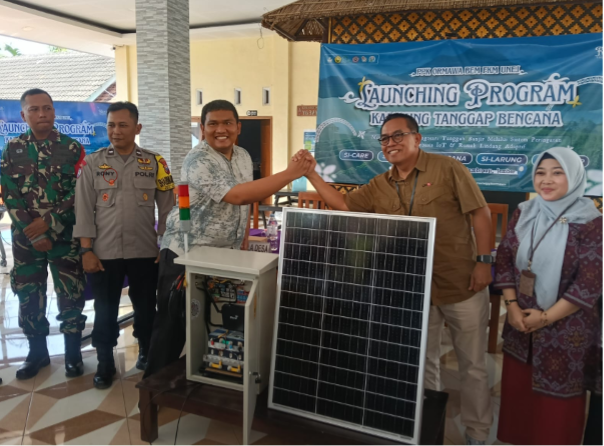
Photo: solar-powered flood early warning device on the Jompo River, or handover of the early warning system to the Nogosari Village Government.
JEMBER – Universitas Jember (UNEJ) helps local government monitor climate disaster risks through early warning technology. This work is based on the cooperation agreement between UNEJ's Faculty of Engineering and the Jember Regency BPBD, in place since 24 March 2022, on early warning systems (EWS), disaster education and information dissemination.
In December 2024, LP2M researchers and the East Java Regional Research and Innovation Agency (BRIDA) developed an Internet of Things flood early warning system that monitors rainfall, river level, temperature and humidity every five minutes, with sirens and a monitoring website.
In 2025, UNEJ's Faculty of Engineering supported Gunungsari Village, Maesan District, Bondowoso Regency, which had been hit by a flash flood on 9 January 2025. Working with the East Java Provincial BPBD and the Bondowoso Regency BPBD, the UNEJ team formed a disaster-resilient village (Destana) volunteer group on 21 June 2025, ran flood mitigation education, mapped evacuation routes with residents and held evacuation drills. The team also designed a solar-powered smart early warning system based on the Internet of Things that monitors water level, turbidity and pH, sounds an alarm and sends WhatsApp alerts when danger indicators are detected. Mitigation signs and a village map were installed on 24–31 July 2025, and the system design and a mitigation guidebook were handed to the village government on 31 July 2025. The programme continued in 2026 with the installation of a solar-powered flood early warning system along the Jompo River and the launch of the Nogosari Disaster-Responsive Village (KAMTAB) with BPBD Jember, which handed the SI-Tanggap early warning system to the village government.
UNEJ support for disaster early warning and risk monitoring
Year | Activity | Government partner | Status |
2022 | Cooperation agreement on EWS, education and disaster information dissemination | BPBD Jember | In force |
2024 | IoT flood EWS (rainfall, water level, temperature, humidity) | East Java BRIDA | Completed |
2025 | Formation of a Destana volunteer group, evacuation route mapping, drills and design of a solar-powered IoT smart flood EWS, Gunungsari Village, Bondowoso | East Java BPBD, Bondowoso BPBD, Gunungsari Village Government | Completed; design and guidebook handed over on 31 Jul 2025 |
2026 | Solar-powered flood EWS on the Jompo River; Nogosari KAMTAB | BPBD Jember, Nogosari Village Government | Continuation |
Supporting documents
▪ https://www.youtube.com/watch?v=Ivn0VY5sX-I
▪ UNEJ Faculty of Engineering signs cooperation agreement with Jember Regency BPBD (24 March 2022)
SDG 13 · Indicator 13.3.5 · Environmental education collaborate with NGO
UNEJ and Ecoton Prepare Suci Village to Become a Climate Village
Collaboration with an environmental NGO prepares a climate-resilient village through the Zero Waste Village movement.
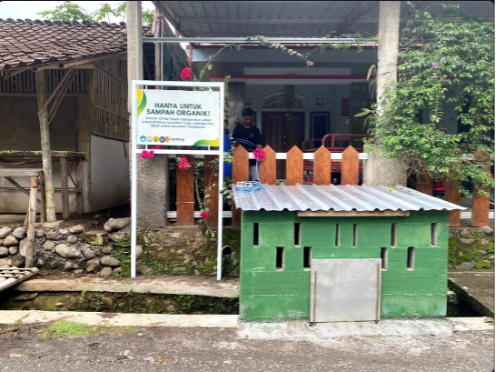
JEMBER – Universitas Jember (UNEJ) works with non-governmental organisations on climate change adaptation. In November 2025, UNEJ's Faculty of Agriculture collaborated with Ecoton (Ecological Observation and Wetlands Conservation), an environmental NGO in East Java, to prepare Suci Village, Jember Regency, for the Climate Village Programme (ProKlim).
The collaboration takes the form of a "Zero Waste Village" movement that aims to make the village both ecologically resilient and economically strong. Ecoton promoted river conservation by establishing a 200-metre river sanctuary zone and releasing native wader fish as an indicator of river health, and supported the adoption of the zero-waste village concept. UNEJ, through its Faculty of Agriculture, introduced sustainable farming and the conversion of agricultural waste into organic fertiliser using Bata Bolong technology. The activities also involved the village waste bank and the Jember Regency TP3D.
ProKlim is a national community-based programme for climate change adaptation and mitigation. The Jember Regency Government established a ProKlim Coordination Team in 2025, so the support provided by UNEJ and Ecoton links directly with the regency's programme. Looking ahead, UNEJ's LP2M is preparing to support more villages joining ProKlim by combining ecosystem-based adaptation with clean energy technology.
UNEJ collaboration with NGOs and community groups on climate adaptation
Partner | Type of partner | Programme | Date | Participants |
Ecoton | Environmental NGO | 200 m river sanctuary, zero-waste village, ProKlim preparation, Suci Village | Nov 2025 | 30 |
Suci Village waste bank | Community group | Waste management to keep pollution out of the river, Suci Village | Nov 2025 | 30 |
Gunungsari Destana volunteers, Bondowoso | Voluntary community group | Evacuation map, flood mitigation education, drills, EWS design | Jun–Jul 2025 | 10 |
Government agencies and universities are not counted as NGO partners.
Supporting documents
▪ https://jplusmedia.com/unej-ecoton-ciptakan-desa-proklim-suci-integrasikan-ekonomi-dan-ekologi/
▪ Jember Regent's Decree on the 2025 ProKlim Coordination Team
SDG 13 · Indicator 13.4.1 · Commitment to carbon neutral university
UNEJ Commits to Becoming a Carbon-Neutral Campus
The Rector's 2025 commitment letter and a GHG Protocol-based greenhouse gas inventory lay the foundation for the path to net zero emissions.
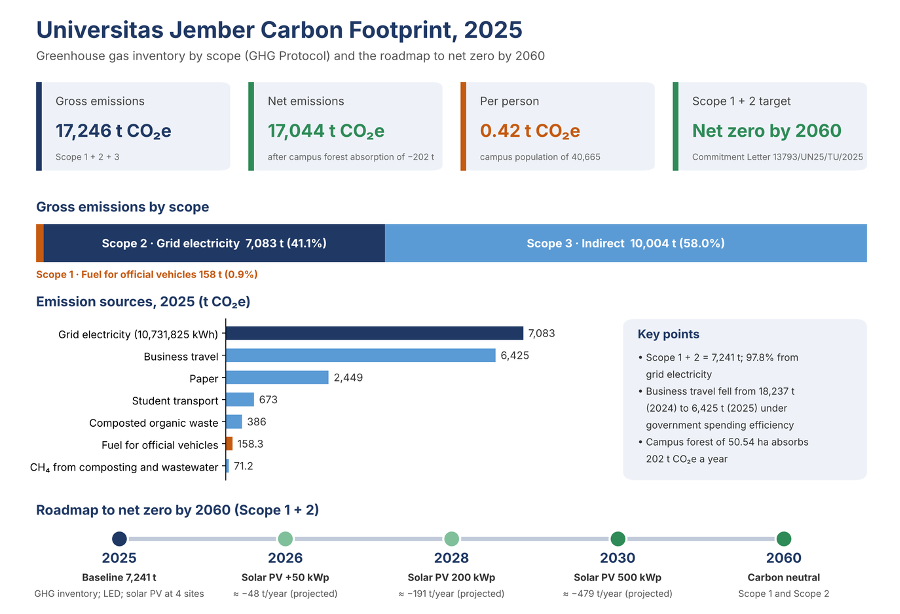
JEMBER – Universitas Jember (UNEJ) is committed to becoming a carbon-neutral university. The commitment is set out in the Universitas Jember Commitment Letter Towards Zero Emission No. 13793/UN25/TU/2025, signed by the Rector on 30 June 2025, with a target of net zero emissions by 2060. The commitment covers Scope 1, Scope 2 and Scope 3 emissions.
The commitment builds on obligations in place since 2018. The Carbon Emission Reduction Standard (GC-04) of the Green Campus Standards requires LP2M to calculate the campus carbon footprint every year, with a target of less than 0.1 tonnes of CO₂e per person.
The 2025 greenhouse gas inventory was prepared under the GHG Protocol Corporate Standard and covers the main and satellite campuses. Scope 1 emissions from fuel for official vehicles were 158.3 tonnes of CO₂. Scope 2 emissions from 10,731,825 kWh of PLN electricity, at an emission factor of 0.660 kg of CO₂ per kWh, were 7,083 tonnes of CO₂. Scope 3 emissions covered business travel (6,425 tonnes), student transport (673 tonnes), paper (2,449 tonnes), composted organic waste (386 tonnes) and methane from composting, septic tanks and domestic wastewater treatment (71.2 tonnes of CO₂e), a total of 10,004 tonnes. Gross emissions were 17,246 tonnes of CO₂e. The 50.54 hectares of campus forest absorbed 202 tonnes, giving net emissions of 17,044 tonnes of CO₂e, or 0.42 tonnes per person.
Business travel emissions fell from 18,237 tonnes in 2024 to 6,425 tonnes in 2025, following the government's spending efficiency policy, which limited official travel. The path to carbon neutrality combines energy efficiency, solar expansion to 500 kWp by 2030, protection of the campus forest and low-carbon mobility. Carbon credits will be counted only if they are high-integrity permanent carbon removals.
Scope of the commitment and UNEJ 2025 emissions baseline
Scope | Coverage | 2025 emissions (t CO₂e) |
Scope 1 | Fuel for official vehicles | 158.3 |
Scope 2 | PLN electricity, 10,731,825 kWh | 7,083 |
Subtotal, Scope 1 + 2 |
| 7,241 |
Scope 3 | Business travel 6,425; student transport 673; paper 2,449; organic waste 386; CH₄ from waste treatment 71.2 | 10,004 |
Gross total |
| 17,246 |
Campus forest absorption | 50.54 ha | −202 |
Net |
| 17,044 |
Supporting documents
▪ Universitas Jember Commitment Letter Towards Zero Emission (Rector, 30 June 2025)
▪ UNEJ Green Campus Standards: GC-04 Carbon Emission Reduction Standard
SDG 13 · Indicator 13.4.2 · Carbon neutrality achieve by date
UNEJ Targets Carbon Neutrality for Scope 1 and 2 by 2060
The target year is set in the Rector's commitment letter and pursued through milestones to 2030.
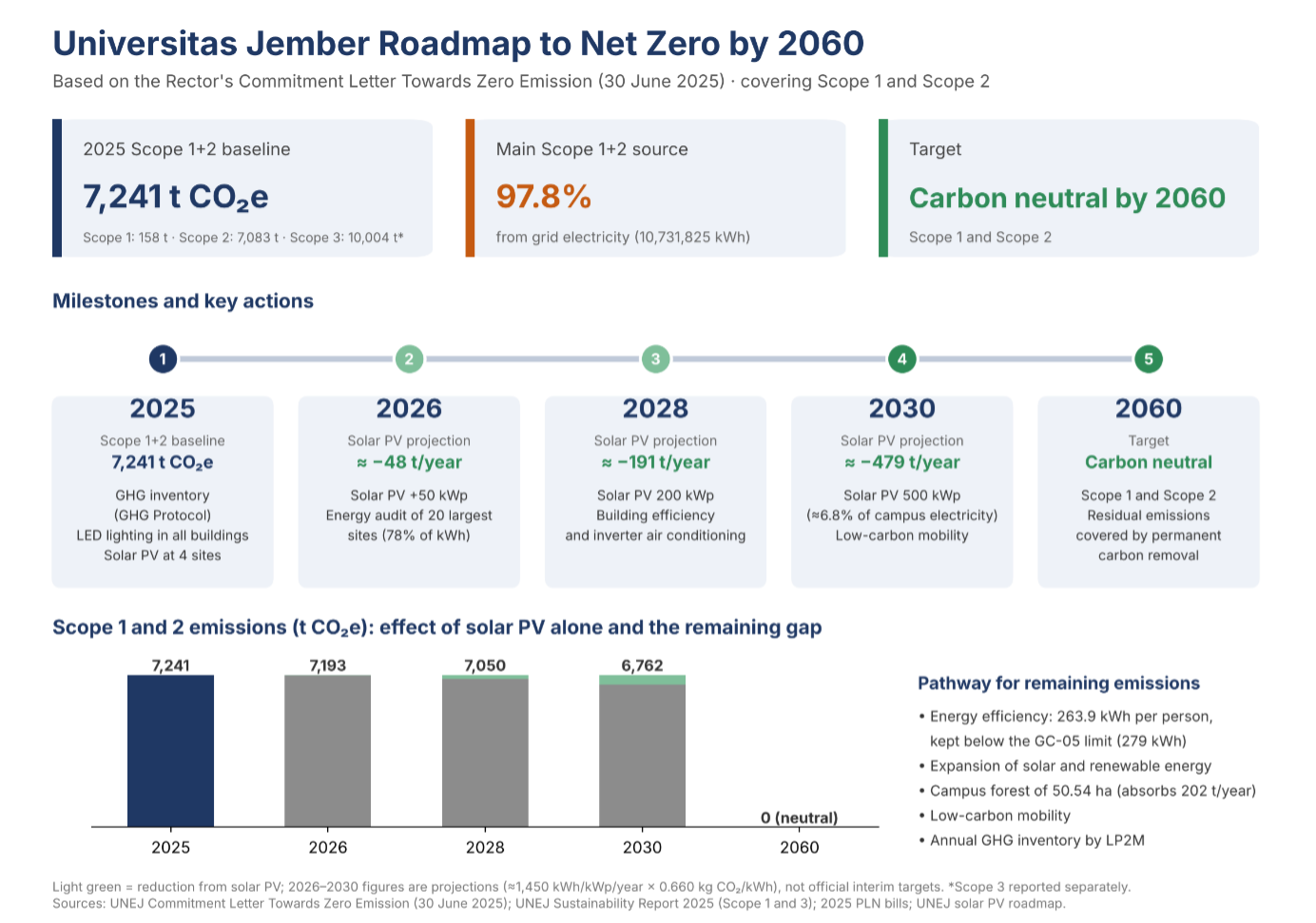
JEMBER – Universitas Jember (UNEJ) targets carbon neutrality for Scope 1 and Scope 2 emissions by 2060. The target is stated in the Universitas Jember Commitment Letter Towards Zero Emission, signed by the Rector on 30 June 2025.
In 2025, UNEJ's Scope 1 and 2 emissions were 7,241 tonnes of CO₂e, 97.8% of them from PLN electricity and the rest from fuel for official vehicles. The main pathway to the target is therefore to reduce electricity use and replace it with renewable energy. The solar roadmap adds 50 kWp in 2025–2026 and reaches 200 kWp in 2027–2028 and 500 kWp by 2030, which is expected to avoid about 479 tonnes of CO₂e a year.
Progress is monitored every year through the greenhouse gas inventory calculated by LP2M under the Green Campus Standards. As a reference, solar expansion is projected to cut emissions by about 48 tonnes of CO₂e a year by 2026, 191 tonnes by 2028 and 479 tonnes by 2030, or about 6.6% of 2025 Scope 1 and 2 emissions. The remaining emissions will be reduced through energy efficiency, further renewable energy, protection of the campus forest and low-carbon mobility.
UNEJ roadmap to carbon neutrality
Year | Milestone | Key actions |
2025 | Scope 1+2 baseline: 7,241 t CO₂e | GHG inventory (GHG Protocol); LED lighting in all buildings; solar PV at 4 sites |
2026 | Projected −48 t CO₂e/year (−0.7%) | Solar PV +50 kWp; energy audit of the 20 largest sites (78% of electricity use) |
2028 | Projected −191 t CO₂e/year (−2.6%) | Solar PV 200 kWp; building efficiency and inverter air conditioning |
2030 | Projected −479 t CO₂e/year (−6.6%) | Solar PV 500 kWp (≈6.8% of campus electricity); low-carbon mobility |
2060 | Carbon neutral for Scope 1 and 2 | Further energy efficiency and renewable energy; 50.54 ha campus forest (absorbing 202 t/year); residual emissions covered by permanent carbon removal |
Supporting documents
▪ Universitas Jember Commitment Letter Towards Zero Emission (Rector, 30 June 2025)