
SDG 12 Universitas Jember 2025
12.2.1 Ethical Sourcing Policy
Universitas Jember (UNEJ) has established policies that promote the ethical sourcing of food and supplies, reflecting its commitment to responsible consumption and production. UNEJ became a Public Service Agency (Badan Layanan Umum, BLU) in December 2020. Since then, its Procurement Work Unit (UKPBJ) has bought food, supplies, equipment and services under Presidential Regulation No. 16 of 2018 on Government Procurement, as amended by Presidential Regulation No. 12 of 2021. The Internal Audit Unit (SPI) publishes these regulations as the rules the University follows.
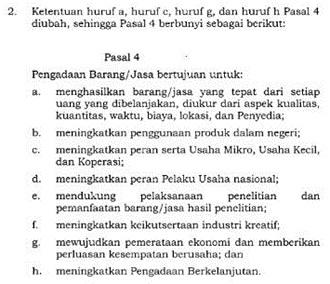
The amended regulation defines sustainable procurement as procurement that delivers value to the buying institution and to society while “significantly reducing negative environmental and social impacts across its whole life cycle” (Article 1, point 50). Article 4 lists the purposes of every purchase, three of which relate to ethics and sustainability:
● Point (b): increase the use of domestic products.
● Point (c): increase the participation of micro and small enterprises and cooperatives.
● Point (h): increase sustainable procurement.
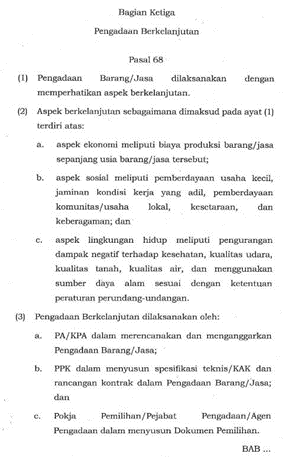
Article 68 of Presidential Regulation No. 16/2018 requires every purchase to consider three aspects:
● Economic: the cost of goods and services over their whole life, not only the purchase price.
● Social: empowering small businesses, guaranteeing fair working conditions, empowering local communities and businesses, equality and diversity.
● Environmental: reducing negative effects on health and on air, soil and water quality, and using natural resources in accordance with the law.
The article also names who must apply these tests. Budget holders apply them when planning and budgeting a purchase, commitment officers (PPK) when writing technical specifications, terms of reference and draft contracts, and selection teams when preparing tender documents.
Article 65, as amended in 2021, requires government institutions to use products of domestic small enterprises and cooperatives. It sets a minimum allocation of 40% of their goods and services expenditure, subject to the applicable provisions. Article 61(2a) confirms that Public Service Agencies such as UNEJ follow the regulation for procurement.
Integrity rules apply to everyone involved in procurement, including suppliers. Article 7 requires them to work in an orderly and responsible way, avoid collusion and conflicts of interest, and prevent the waste and leakage of public funds. They must also “not accept, offer or promise gifts, rewards, commissions or rebates” connected to procurement. UNEJ reinforces these rules with an anti-bribery management system based on SNI ISO 37001, whose compliance function sits within the Internal Audit Unit, and with Rector Regulation No. 5 of 2023 on the University’s Code of Ethics.
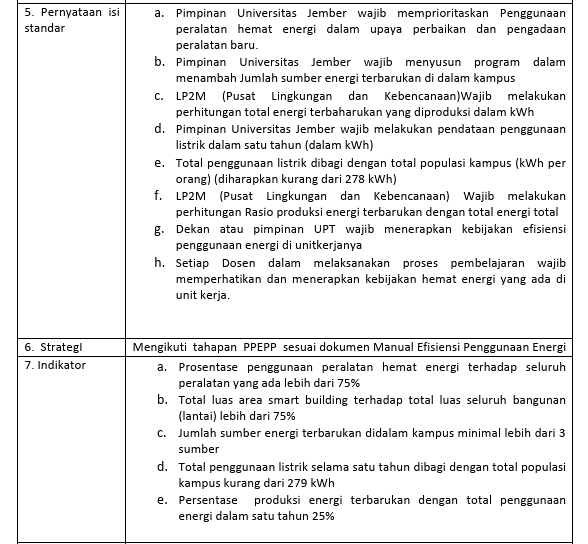
UNEJ also writes environmental purchasing rules into its own Green Campus Standard (Rector Decree No. 9026/UN25/KP/2018, revised 2020), which is part of its internal quality assurance system:
● GC-05 Energy Efficiency (7 December 2019): University leaders must “prioritise energy-efficient equipment in repairs and in the procurement of new equipment” (point 5a). The standard names inverter air conditioners and LED lamps as examples (point 3a) and sets a target of more than 75% of equipment in use being energy-efficient (indicator 7a).
● GC-07 Water Resources: water-saving fittings, such as automatic sensor taps, are required (point 5e).
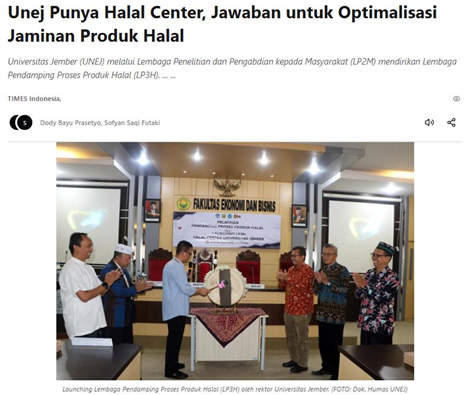
For food, ethical sourcing at UNEJ also covers halal assurance. On 12 October 2023, the University’s Institute for Research and Community Service (LP2M) launched the UNEJ Halal Center and its Halal Product Process Assistance Institute (LP3H) in the hall of the Faculty of Economics and Business. The Center oversees halal compliance at every stage of food production, from raw materials to distribution, in line with Law No. 33 of 2014 on Halal Product Assurance. At the launch, UNEJ trained halal process assistants and supported 10 micro and small enterprises (UMKM) in registering for halal certification. It also provides local food producers with training, research and product development support.
References:
https://peraturan.bpk.go.id/Details/161828/perpres-no-12-tahun-2021
https://peraturan.bpk.go.id/Details/73586/perpres-no-16-tahun-2018
https://unej.ac.id/wp-content/uploads/2025/06/R2020-Buku-Standar-Green-Campus-9-UNEJ2018-5.pdf
12.2.2 Policy Waste Disposal-hazardous Material
Universitas Jember (UNEJ) has established policies and procedures for managing hazardous and toxic waste (limbah bahan berbahaya dan beracun, or B3 waste) from its teaching, research, and healthcare activities. Its Green Campus Standard, occupational safety regulations, and unit-level procedures set out how this waste must be separated, stored, monitored, and handed over for treatment.
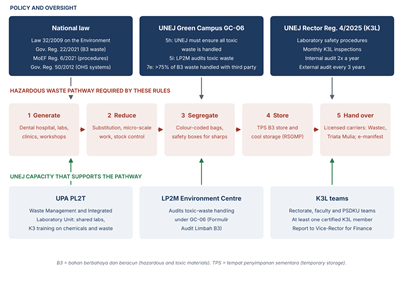
UNEJ’s hazardous-waste governance and handling pathway. Source: UNEJ SDG 12 evidence draft.
The University’s Green Campus Standard GC-06 applies to every faculty and unit. It requires UNEJ to ensure that all toxic waste is properly managed and assigns the LP2M Environment and Disaster Centre responsibility for auditing hazardous-waste management. The standard also sets a target for more than 75% of B3 waste to be handled in cooperation with third parties.
These commitments are supported by Rector Regulation No. 4 of 2025 on Occupational Safety, Health and Environment (K3L). The regulation provides guidance for laboratory safety and chemical incidents, requires inspections at least once a month, and calls for internal audits at least twice a year.
Separating and Storing Hazardous-waste Safely
At the Teaching Dental Hospital (RSGMP), a written procedure sets out four stages: sorting waste at its source, moving filled bags to temporary storage, handing waste to a licensed contractor, and recording each step. Colour-coded bags are used for different waste categories, while sharps are placed in safety boxes.
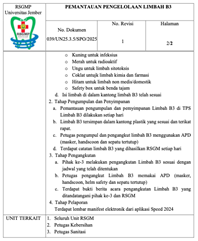
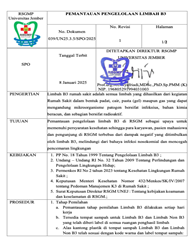
The Teaching Dental Hospital’s SOP for monitoring hazardous waste management (issued 6 January 2025). Source: UNEJ SDG 12 evidence draft.
The Teaching Dental Hospital’s SOP for monitoring hazardous waste management
UNEJ also operates a dedicated, labelled temporary storage site for B3 waste. Infectious waste awaiting collection is kept in a separate cool-storage room with colour-coded bins. These facilities help keep hazardous waste apart from general campus waste before collection and treatment.
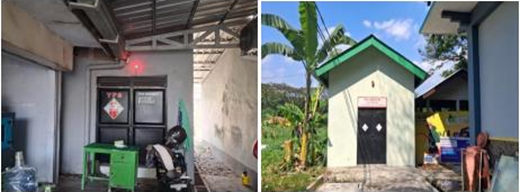
Figure 3. UNEJ temporary storage site for B3 waste (TPS Limbah B3). Source: UI GreenMetric Evidence 3.16
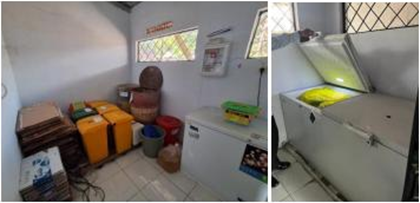
Figure 4. Cool storage room for B3 (infectious) waste, with colour-coded bins. Source: UI GreenMetric Evidence 3.16
Working with Licensed waste-treatment Companies
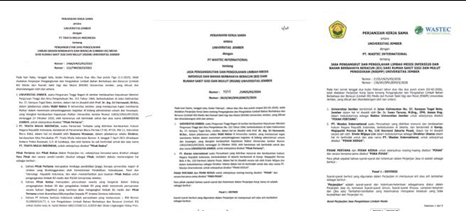
UNEJ’s evidence records cooperation with licensed third parties to transport and treat hazardous waste. PT Triata Mulia Indonesia was listed for medical B3 waste from the Teaching Dental Hospital in 2023, while PT Wastec International appears in the 2024 records for infectious medical and B3 waste from RSGMP. The draft also documents an on-campus incinerator as part of the University’s waste-treatment infrastructure; it does not establish that every type of B3 waste is treated by incineration.
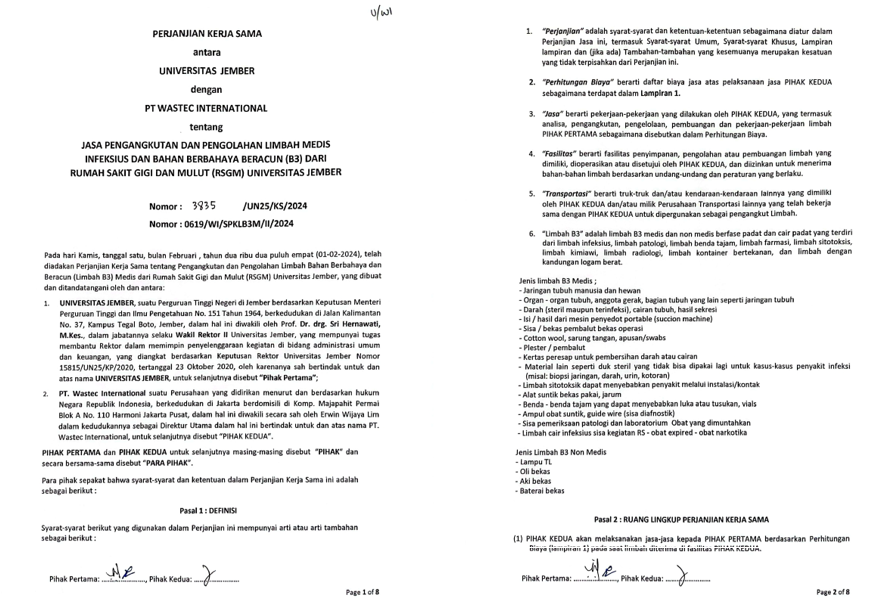
Figure 5. Cooperation agreements between UNEJ and licensed B3 waste contractors (2023, 2024). Source: UI GreenMetric Evidence 3.16
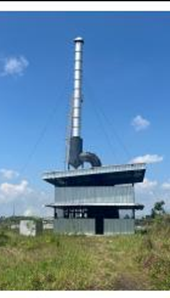
Figure 6. Incinerator facility, Universitas Jember. Source: UI GreenMetric Evidence 3.16
Reported waste-treatment Result
UNEJ’s reported UI GreenMetric data show that the amount of B3 waste treated matched the amount generated in each year from 2023 to 2025. The reported totals were 8.27 tonnes in 2023, 8.27 tonnes in 2024 and 7.65 tonnes in 2025, with 100% recorded as treated in each year. These figures refer to the data reported in the evidence and should not be read as a separate verification of every waste stream beyond that reporting.
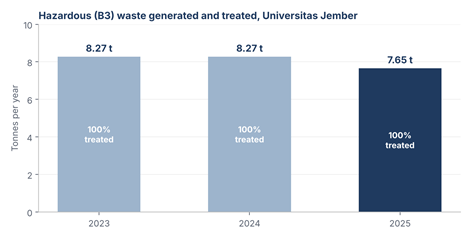
Figure 7. Hazardous (B3) waste generated by UNEJ, 2023–2025; 100% treated each year. Source: UNEJ UI GreenMetric data
UNEJ also provides training related to laboratory, chemical and waste safety. On 8–9 June 2024, the Waste Management and Integrated Laboratory Unit (UPA PL2T) held a workshop for building managers, technicians and laboratory technicians at Agrotechnopark Jubung. The activities included fire-response training and practical guidance on chemical and waste safety.
Through university-wide rules, waste separation, dedicated storage, licensed contractor partnerships and monitoring, UNEJ’s approach supports SDG 12: Responsible Consumption and Production. Continued implementation and transparent reporting are important to ensure hazardous waste is managed safely and responsibly.
References:
Universitas Jember. (2020). Buku Standar Green Campus Universitas Jember (Rector Decree No. 9026/UN25/KP/2018, revised 2020): GC-06 Standar Penanganan Limbah [Waste Handling Standard], 7 December 2019, revision 1. https://unej.ac.id/wp-content/uploads/2025/06/R2020-Buku-Standar-Green-Campus-9-UNEJ2018-5.pdf
Rektor Universitas Jember. (2025, May 19). Peraturan Rektor Universitas Jember Nomor 4 Tahun 2025 tentang Keselamatan dan Kesehatan Kerja serta Lingkungan (K3L) di Universitas Jember. https://drive.google.com/file/d/13AS2JeAxB8XDgHBZ-qXS6ENJLcu_J3zv/view
Universitas Jember. (2025, April 22). Peraturan Rektor 2025 https://unej.ac.id/blog/2025/04/22/peraturan-rektor-2025/
Government of Indonesia. (2009). Law (UU) No. 32 of 2009 on Environmental Protection and Management. JDIH BPK. https://peraturan.bpk.go.id/Details/38771/uu-no-32-tahun-2009
Government of Indonesia. (2021). Government Regulation (PP) No. 22 of 2021 on the Implementation of Environmental Protection and Management. JDIH BPK. https://peraturan.bpk.go.id/Details/161852/pp-no-22-tahun-2021
Ministry of Environment and Forestry. (2021). Regulation (Permen LHK) No. 6 of 2021 on Procedures and Requirements for Hazardous and Toxic Waste Management. https://www.dlh.kendalkab.go.id/media/document/permen-lhk-no6-tahun-2021-tentang-tata-cara-dan-persyaratan-pengelolan-limbah-bahan-berbahaya-dan-beracun.pdf
UPA Pengelolaan Limbah dan Laboratorium Terpadu (UPA PL2T) Universitas Jember. (n.d.). Profil. https://upapl2t.id/profil/
UPA PL2T Universitas Jember. (2024, June 9). UPA PL2T melaksanakan kegiatan workshop K3. https://upapl2t.id/artikel/upa-pl2t-melaksanakam-kegiatan-workshop-k3/
12.2.3. Policy on Waste Disposal - Landfill Policy
Universitas Jember (UNEJ) has policies and procedures for managing hazardous and toxic waste (limbah bahan berbahaya dan beracun, or B3 waste) from its teaching, research and healthcare activities. A university with a teaching dental hospital, a pharmacy faculty and many science laboratories produces used needles, expired drugs, reagents and solvents every day. Law No. 32 of 2009 on Environmental Protection makes every producer responsible for managing the waste it generates.
UNEJ’s Green Campus Standard GC-06 on Waste Handling (7 December 2019, revision 1) sets the rules:
● Point 5h: “Universitas Jember wajib menjamin penanganan seluruh limbah beracun” (the University must ensure the handling of all toxic waste).
● Point 5i: the LP2M Environment and Disaster Centre audits toxic-waste management.
● Indicator 7e: more than 75% of B3 waste must be handled in cooperation with licensed third parties.
The standard also requires a dedicated hazardous-waste audit form, separate from the forms for general and liquid waste.
The policy was reviewed in 2025. On 19 May 2025 the Rector issued Rector Regulation No. 4/2025 on Occupational Safety, Health and Environment (K3L), which makes K3L standards the guideline for the whole University:
● Article 4: laboratory procedures covering work safety, practicals, research use, equipment lending and maintenance.
● Article 5: the K3L section inspects at least once a month and reports to the Rector through the Vice-Rector for Finance and General Affairs.
● Article 6: every unit is audited internally at least twice a year and externally by a certified body at least once every three years.
● Article 8: K3L teams at each level include at least one person certified in K3L.
At the Teaching Dental Hospital, a Standard Operating Procedure set by the hospital Director on 6 January 2025 defines four stages: sorting at source, collection and storage, transport, and reporting. Colour-coded containers are used in every treatment room: yellow for infectious waste, purple for cytotoxic, red for radioactive, brown for chemical and pharmaceutical, and black for non-medical waste, with puncture-proof safety boxes for sharps. Trained staff wearing protective equipment move filled bags to the temporary B3 store, and every step is recorded on monitoring sheets.
The temporary B3 store is a closed, labelled building kept separate from general waste facilities. Infectious waste waiting for collection is kept cold in chest freezers in a dedicated room with colour-coded bins.
Collection and treatment of infectious medical and B3 waste from the dental hospital are covered by written agreements with licensed companies: PT Triata Mulia Indonesia in 2023 and PT Wastec International from 2024,
UNEJ’s data reported to UI GreenMetric record all hazardous waste as treated in each year:
References:
Buku Standar Green Campus Universitas Jember (GC-06 Waste Handling Standard)
UI GreenMetric Evidence 3.16: Toxic Waste Treatment (store, cool storage, agreements, SOP)
UI GreenMetric waste data (toxic waste generated and treated, 2023–2025)
Law No. 32 of 2009 on Environmental Protection and Management
12.2.4 Policy for Minimisation of Plastic Use
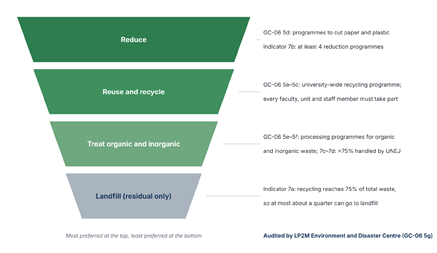
Jember, like many Indonesian regencies, has relied on an open-dumping landfill at Pakusari. Universitas Jember (UNEJ) therefore built its waste policy around a simple idea: measure what is produced, divert as much as possible, and send only the residue to landfill. Green Campus Standard GC-06 (7 December 2019) sets the hierarchy:
● Point 5a: University leaders run a recycling programme.
● Points 5b–5c: deans, work units, lecturers and staff take part.
● Point 5d: programmes to reduce paper and plastic.
● Points 5e–5f: programmes to process organic and inorganic waste.
● Point 5g: the LP2M Environment and Disaster Centre audits these programmes using a waste-management audit form.
The standard sets targets that can only be checked by measuring:
● Indicator 7a: recycling reaches 75% of total waste.
● Indicator 7b: at least four waste-reduction programmes.
● Indicators 7c–7d: more than 75% of organic waste and more than 75% of inorganic waste are handled.
● Indicator 7e: more than 75% of hazardous waste is handled with licensed third parties.
Standard GC-09 (point 5j) then requires the data to be compiled every year for the sustainability report and the UI GreenMetric submission.
Faculty procedures turn the policy into routine. The Faculty of Pharmacy’s SOP on Waste Handling was made on 19 August 2024, approved by the Dean, Dr. apt. Nuri, S.Si., M.Si., and took effect on 2 September 2024, based on Law No. 18/2008 on Waste Management and Government Regulation No. 81/2012. Cleaning staff collect waste from rooms, laboratories and grounds (60 minutes), separate organic from inorganic waste (60 minutes), bag each fraction separately (30 minutes), and transport them by motor cart (60 minutes). Organic waste goes to UPA Agroteknologi and inorganic waste to the University disposal site.
Faculty of Pharmacy SOP on Waste Handling
On 30 June 2025, the Rector signed a Commitment Letter, “Universitas Jember Towards Net Zero/Zero Emission”. It links the University’s climate goals to the SDGs and includes facilitating waste management with sorted bins and waste treatment facilities.

Organic waste goes to UPA Taman Agroteknologi, which composts it on campus. UNEJ’s 2024 Sustainability Report describes sorting into five categories, composting at the Agrotechnopark compost house, and states that the University manages more than 75% of its organic waste. Inorganic waste is weighed by UPA Limbah and sold to waste banks and recyclers. Hazardous waste goes to licensed contractors.
The policy reaches beyond campus. On 27 July 2025, students in the Promadesa (Students in the Village) programme launched a “Green Bank” in Dusun Krajan, Kemuninglor village, Arjasa, Jember. Residents sort waste into at least three types and deposit it once a month. The bank buys plastic at Rp1,350 per kilogram and cardboard at Rp850.
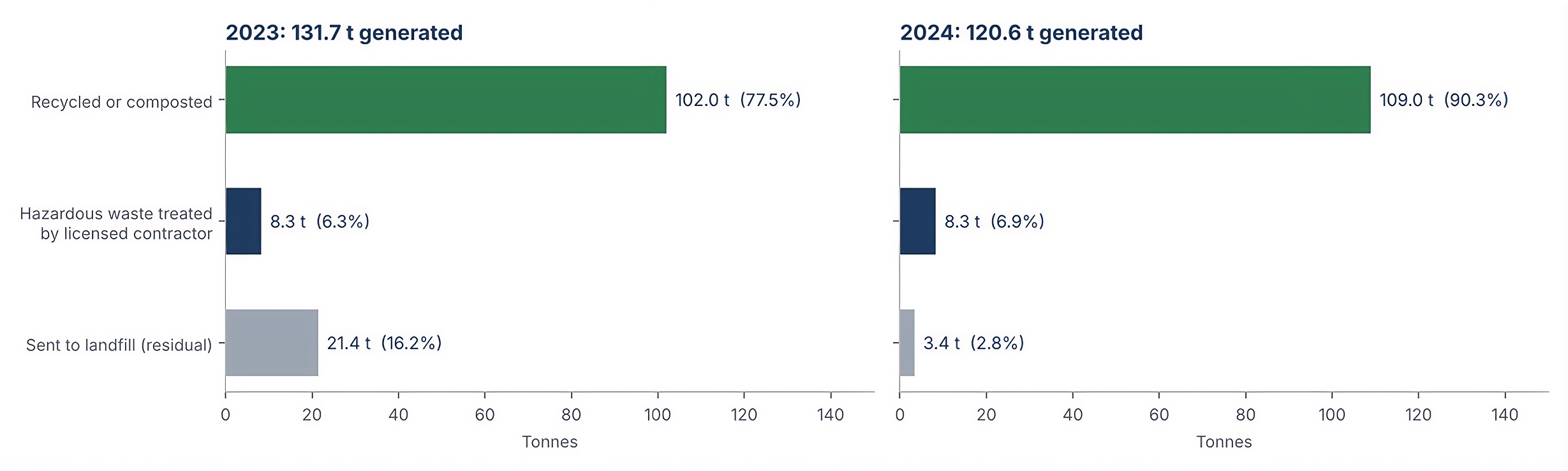
The reported results show the direction. Waste sent to landfill fell from 21.4 tonnes in 2023 (16.2% of waste) to 3.4 tonnes in 2024 (2.8%), while the share recycled or composted rose from 77.5% to 90.3%.
References:
12.2.5. Policy for Minimisation of Disposable Items
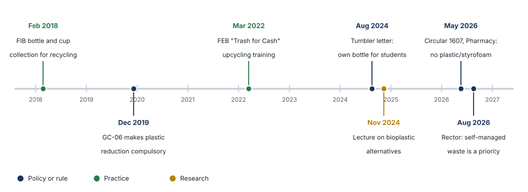
Universitas Jember (UNEJ) reduces plastic through a university-wide standard and practices that reach students, faculties and researchers. Green Campus Standard GC-06 requires University leaders to “have campus programmes to reduce the use of paper and plastic on campus” (point 5d). It sets a target of at least four such programmes (indicator 7b) and makes the LP2M Environment and Disaster Centre responsible for auditing them every year (point 5g). Deans, every work unit, and all lecturers and staff must take part (points 5b–5c).
The policy was updated for the University’s largest event. For the new-student orientation (PKKMB) in August 2024, UNEJ sent an official notice on the use of tumblers to all faculties and to the satellite campuses in Bondowoso, Lumajang and Pasuruan. Every new student had to bring a personal 600 ml drinking bottle instead of buying bottled water.
Official notice
The alternative is provided as well. Free drinking-water refill points for students, staff and visitors are promoted through the “Bawa Tumbler, Isi Ulang Gratis!” (bring a tumbler, refill for free) campaign.
Faculties have built their own programmes on the University policy:
● Faculty of Cultural Sciences: since February 2018, a student-managed collection point for plastic bottles and cups. The materials are sold for recycling and the proceeds support education for street children.
● Faculty of Economics and Business: on 11–12 March 2022, “Trash for Cash” training for cleaning staff, lecturers and administrative staff on plastic upcycling and composting.
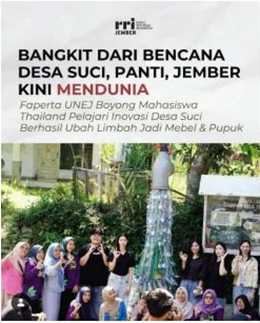
● Faculty of Agriculture: exchange students from Mahasarakham University, Thailand, studied how Suci village in Panti, Jember, turns plastic and other waste into furniture and fertiliser.
UNEJ also supports research on alternatives to plastic. At the University’s 60th-anniversary scientific lecture on 11 November 2024, Faculty of Engineering lecturer Dr. M. Asrofi presented work on bioplastics and biocomposites from agricultural waste: mango seed waste, water hyacinth, oil palm empty fruit bunches and sugarcane bagasse. Mango seeds are turned into gelatin and then into food-packaging plastic. According to the lecture, it resisted heat better than common LDPE bags in laboratory tests. Bagasse fibre is made into paper for food wrapping and boxes, and oil palm fibre into board strong enough for egg trays.
References:
Kurangi sampah plastik, Aruna UNEJ bawa botol minum pribadi (19 August 2024)
Orasi ilmiah Dies Natalis ke-60 Universitas Jember tawarkan biokomposit (11 November 2024)
Dosen UNEJ ciptakan biokomposit guna kurangi sampah plastik (Antara Jatim)
12.2.6 Disposable Policy: Extensions to Services

Universitas Jember (UNEJ) minimises disposable items through Green Campus Standard GC-06, which requires University leaders to run programmes that reduce paper and plastic (point 5d), with at least four reduction programmes (indicator 7b) audited by the LP2M Environment and Disaster Centre. In practice, each common disposable item has a rule or a reusable or digital alternative.
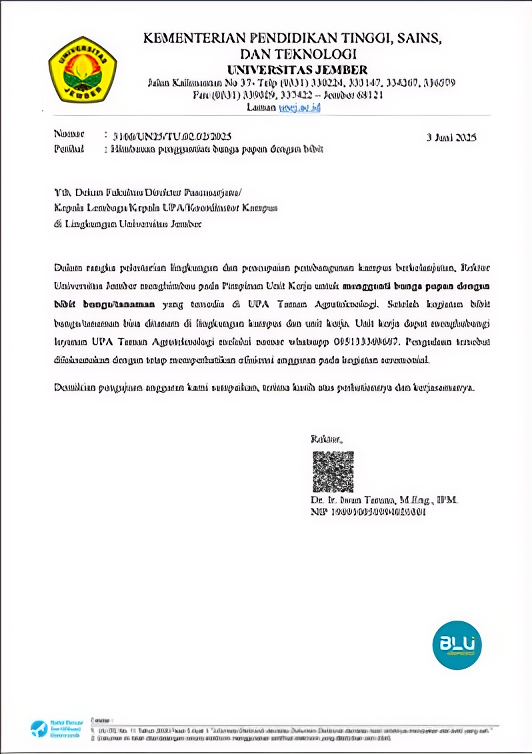
One of the most visible examples is the congratulatory flower board (papan bunga), usually displayed for a day or two at ceremonies and then thrown away. On 3 June 2025, the Rector issued Appeal No. 5166/UN25/TU.02.02/2025 to all deans, the postgraduate director, heads of institutes and units, and campus coordinators. Citing environmental preservation and a sustainable campus, the appeal asks units to replace flower boards with flower or plant seedlings from UPA Taman Agroteknologi. After the event, the seedlings are planted in the campus grounds and in the units, while ceremonial budgets stay efficient.
For drinks, the University replaced disposable cups and bottles with personal tumblers, compulsory for new students since the 2024 orientation, and with free refill points across campus.
Paper is the most widespread disposable item in any university, so UNEJ’s IT unit (UPA TIK) runs services that remove it from daily work:
● E-Surat / E-Office: handles official correspondence.
● SINDE: the national electronic official-document system. On 3–4 December 2022, UNEJ trained 72 staff to use it.
● SIKD: the dynamic archive system that manages official records digitally.
● SIAKAD and the digital repository: students register for courses and receive grades and transcripts online, and theses and publications are deposited digitally rather than printed and bound.
References:
12.2.7 Minimisation policies extended to suppliers
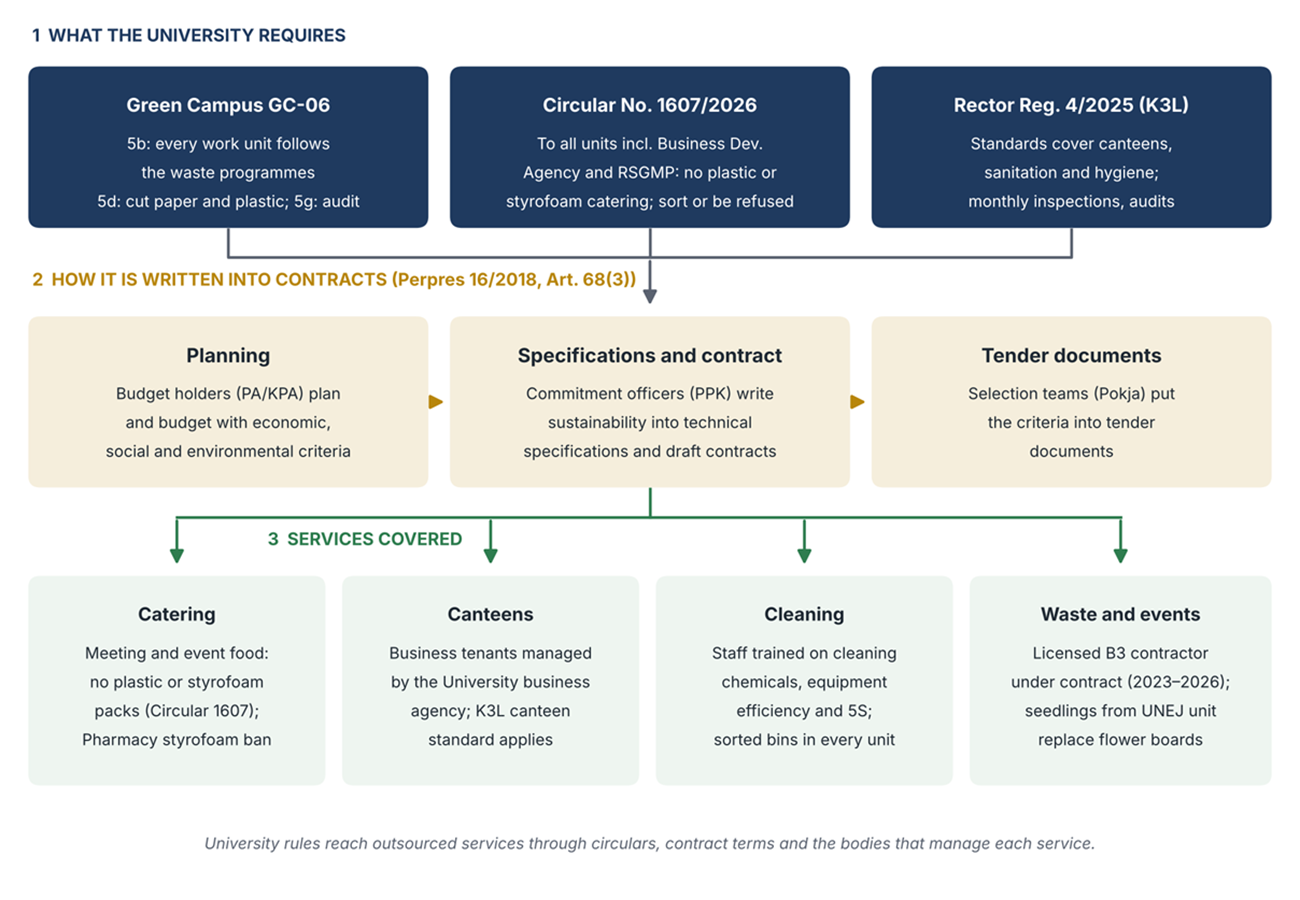
Much of a campus’s waste is created or handled by people who are not University employees: caterers, canteen tenants, cleaning services and specialist contractors. Universitas Jember (UNEJ) extends its plastic and disposable-item policies to them in four ways.
1. Through the units that hire them. Green Campus Standard GC-06 binds every work unit to the University’s recycling and plastic-reduction programmes (points 5b and 5d). A unit that orders catering or cleaning cannot exempt its contractors from rules that bind the unit itself.
2. Through contracts. Article 68(3) of Presidential Regulation No. 16/2018 requires commitment officers to write environmental criteria into the technical specifications and draft contracts of outsourced services, and selection teams to include them in tender documents.
3. Through procedures for cleaning staff. The Faculty of Pharmacy’s SOP on Waste Handling, effective 2 September 2024, specifies what cleaning staff must do: sort organic from inorganic waste, bag each fraction separately, and deliver organic waste to UPA Agroteknologi and inorganic waste to the University disposal site. UNEJ’s human resources section also trains cleaning staff in cleaning tasks, safe use of cleaning chemicals, efficient use of equipment and the 5S workplace method.
4. Through standards and monitoring for canteens. Campus canteens are run by business tenants under University business management, which tracks each tenant’s sales and transactions every month and recognises the best performers. Rector Regulation No. 4/2025 includes canteens in the University’s building safety standards and sanitation and hygiene in its health standards, and its monthly K3L inspections cover every unit. Hazardous-waste contractors work under written cooperation agreements (see 12.2.3).

References:
12.2.8 Policies extended to outsourced suppliers
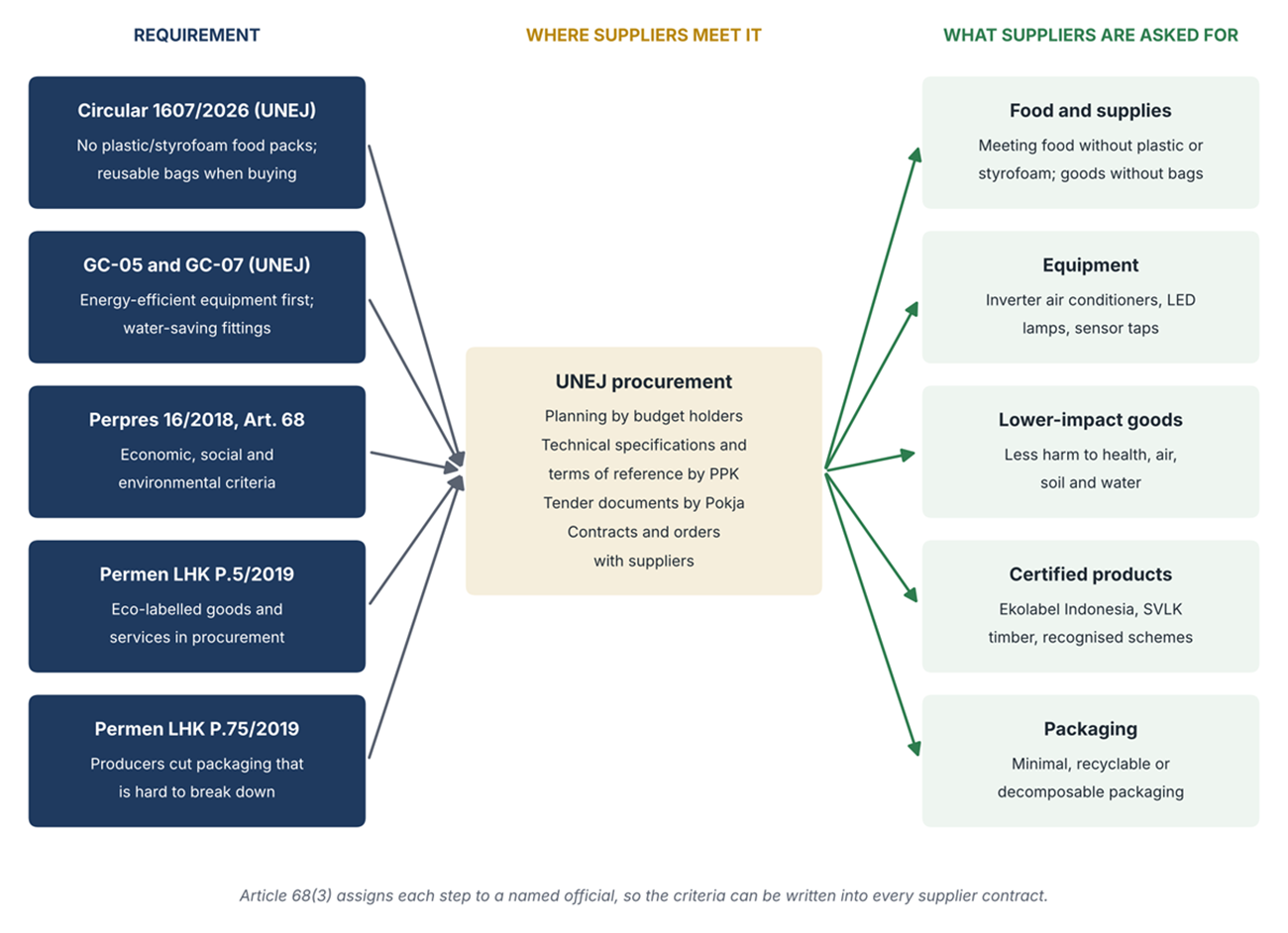
Suppliers meet Universitas Jember’s (UNEJ) environmental rules at one point: the procurement process. Article 68(3) of Presidential Regulation No. 16/2018 requires commitment officers (PPK) to write sustainability into technical specifications, terms of reference and draft contracts, and selection teams to write it into tender documents. The environmental aspect they must apply covers reducing harm to health and to air, soil and water quality. The Procurement Work Unit (UKPBJ) and commitment officers are responsible for applying these requirements.
For equipment and building works, UNEJ uses its Green Campus Standards as a guide to what suppliers should provide:
● GC-05 Energy Efficiency: energy-efficient equipment, defined as inverter air conditioners and LED lamps, with a target of more than 75% of equipment in use.
● GC-07 Water Resources: water-saving fittings such as automatic sensor taps in buildings.
These requirements apply to suppliers of electrical equipment and to contractors for new buildings and renovations.
Suppliers are also bound by national rules on products and packaging. Ministry of Environment and Forestry Regulation No. P.5/2019 sets how eco-labels, such as Ekolabel Indonesia and the SVLK timber legality system, are used in procuring environmentally friendly goods and services. Regulation No. P.75/2019 requires producers in manufacturing, food and beverage services and retail to cut waste from their products and packaging, with a target of a 30% reduction by 2029.
References:
SDG 12.3.1 Waste tracking
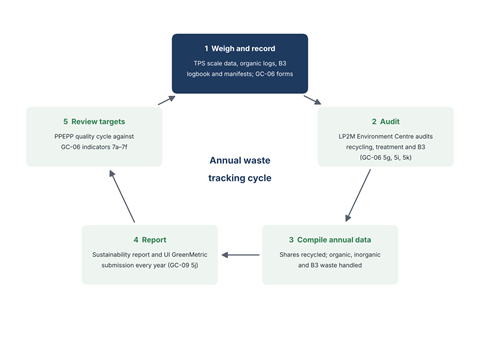
Managing campus waste requires more than providing recycling facilities. Universities also need to understand how much waste they generate and how much can be recycled or treated. At Universitas Jember (UNEJ), waste management is included in its Green Campus Standard. The standard establishes recycling programmes, waste-treatment responsibilities, and an auditing process to support more effective waste management across the university.
Establishing a University-Wide Waste Management Standard
UNEJ's Green Campus Standard GC-06, issued on 7 December 2019, provides guidance for managing waste across the university. It requires university leaders to establish recycling programmes and waste-treatment systems for organic and inorganic materials. Faculties and work units are also required to participate in the university's recycling programmes. This makes waste management a shared responsibility across the institution.
Monitoring Waste Management Programmes
The standard also assigns the Environmental and Disaster Management Centre under LP2M a role in auditing the efficiency of waste-recycling programmes. The audits cover waste recycling, paper and plastic reduction, and organic and inorganic waste treatment. This monitoring process provides a framework for evaluating how waste-management programmes are implemented across UNEJ.
Setting Targets for Recycling and Waste Treatment
UNEJ's Green Campus Standard includes several indicators for waste management. It sets a target for recycling programmes to cover 75% of total waste. It also requires the university to handle more than 75% of the organic waste generated and more than 75% of inorganic waste. These indicators provide targets for improving waste management and assessing the university's environmental performance.
Supporting Waste Management at the Faculty Level
Waste management initiatives are also carried out at the faculty level. In May, the Faculty of Pharmacy held a socialisation programme on independent waste management. The initiative encouraged waste reduction, separation of waste, and more responsible handling of materials within the faculty. Such activities can support the wider implementation of UNEJ's waste-management standards.
Strengthening Data-Based Waste Management
A reliable waste-tracking system is important for understanding the university's environmental performance. Recording the total waste generated and the amount recycled would allow UNEJ to evaluate progress against its Green Campus indicators. Regular monitoring across faculties and work units can also help identify areas that need improvement. Through its waste-management standards and auditing responsibilities, UNEJ has established a framework for strengthening more systematic and measurable waste management.
Evidences:
[1] https://peraturan.bpk.go.id/Details/73586/perpres-no-16-tahun-2018
[2] https://peraturan.bpk.go.id/Details/161828/perpres-no-12-tahun-2021
[3] https://spi.unej.ac.id/pengadaan-barang-dan-jasa/
[4] https://drive.google.com/file/d/18v-qQY5U-_5d3XfOZypvlCBhkaX4b57U/view
[5] https://unej.ac.id/wp-content/uploads/2025/06/R2020-Buku-Standar-Green-Campus-9-UNEJ2018-5.pdf
[6] https://drive.google.com/file/d/18yR9CDlUOhj9TC9na0SzE2fz9staZ2fk/view
[7] https://peraturan.bpk.go.id/Details/285660
[8] https://peraturan.go.id/files/bn1545-2019.pdf
[10] https://spi.unej.ac.id/wp-content/uploads/2021/10/08_Buku-PEDOMAN-AUDIT-SMM-SMAP.pdf
[11] https://drive.google.com/drive/folders/12OlFbaTuXz9ujYrfVOw1nMn1H2NbwMwq
SDG 12.3.2 Proportion of waste recycled
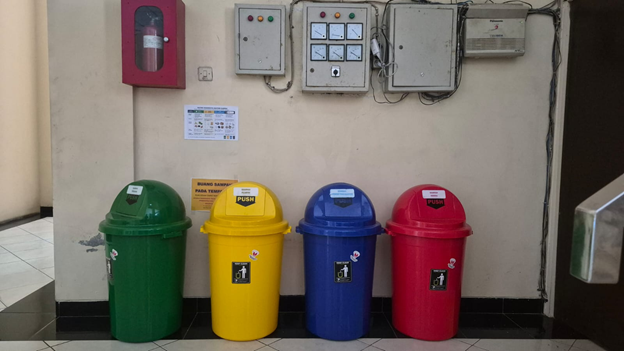
Measuring waste recycling is important for understanding how effectively a university manages its environmental impact. Universities need to know not only how much waste they generate, but also how much is recycled and how much is sent to landfill. At Universitas Jember (UNEJ), waste management is part of its Green Campus commitment, which provides standards and programmes for handling organic and inorganic waste.
Establishing a Framework for Waste Recycling
UNEJ's Green Campus Standard GC-06 provides guidance for managing waste across the university. It requires the implementation of recycling programmes and the treatment of organic and inorganic waste. Faculties and work units are also expected to participate in these programmes. The standard establishes waste recycling as an institutional responsibility rather than an activity limited to individual campus communities.
Measuring Waste Generation and Recycling
To evaluate recycling performance, the amount of waste recycled needs to be compared with the total amount of waste generated. The proportion can be calculated by dividing the recycled waste volume by the total waste volume and multiplying the result by 100. This calculation helps the university assess how much of its waste is recovered instead of being disposed of.
The UI GreenMetric waste questionnaire also provides a reporting structure for waste management. It asks universities to report the total volume of organic and inorganic waste produced and the volume treated. These figures can help UNEJ assess its waste-treatment performance and identify areas that need improvement.
Reducing the Amount of Waste Sent to Landfill
Recycling and waste treatment can reduce the amount of waste that requires final disposal. UNEJ's Green Campus Standard encourages the management of both organic and inorganic waste through recycling and treatment programmes. Tracking the amount sent to landfill alongside the amount recycled would provide a clearer picture of the university's waste-management performance.
Supporting Waste Management at the Faculty Level
Waste-management initiatives are also implemented at the faculty level. In May, the Faculty of Pharmacy held a socialisation programme on independent waste management. The initiative encouraged waste reduction, waste separation, and more responsible handling of materials. Such activities support the wider implementation of UNEJ's Green Campus commitment.
Towards More Measurable Recycling Performance
A consistent waste-recording system can help UNEJ evaluate its recycling performance over time. By recording total waste generated, recycled waste, and waste sent to landfill, the university can calculate its recycling proportion and monitor progress. These figures would also help identify opportunities to improve waste sorting, recycling facilities, and waste-treatment programmes across campus.
Evidence:
[1] https://drive.google.com/file/d/10c-8H3oxf2fqnrvARpxHZb9YpgF0fxkp/view
[2] https://unej.ac.id/wp-content/uploads/2025/06/R2020-Buku-Standar-Green-Campus-9-UNEJ2018-5.pdf
[3] https://drive.google.com/file/d/18yR9CDlUOhj9TC9na0SzE2fz9staZ2fk/view
[4] https://uigreenmetric.com/university/unej.ac.id
[5] https://drive.google.com/drive/folders/12OlFbaTuXz9ujYrfVOw1nMn1H2NbwMwq
SDG 12.4.1 Publication of sustainability report
Universities have responsibilities beyond teaching and research. They also need to communicate how their activities affect the environment, society, and institutional governance. Universitas Jember (UNEJ) demonstrates this commitment by publishing sustainability reports that document its progress and contributions to sustainable development. Through these reports, the university provides stakeholders with information about its sustainability initiatives and institutional performance.
Publishing Sustainability Reports Regularly
UNEJ has published sustainability reports for three consecutive years, covering 2023, 2024, and 2025. These publications document the university's sustainability activities and progress. The 2024 report, titled Establishing Green Campus, contains 343 pages and presents UNEJ's efforts to strengthen its environmental commitment. The reports provide a record of the university's sustainability initiatives over time.
Providing Public Access to Sustainability Information
Transparency is an important part of sustainability reporting. UNEJ makes its reports available through digital documents that can be accessed by readers online. The university also provides a collection of its sustainability reports in a dedicated document folder. This allows students, employees, researchers, and the wider public to review its sustainability information without needing to request printed copies.
Receiving Recognition for Sustainability Reporting
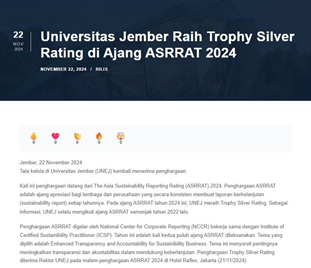
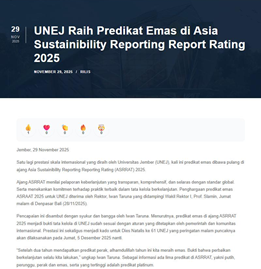
UNEJ's reporting efforts have also received recognition through the Asia Sustainability Reporting Rating (ASRRAT). In 2024, UNEJ received a Silver Rating for its sustainability report. The university had participated in ASRRAT since 2022. In November 2025, UNEJ improved its achievement by receiving the Gold Rating. ASRRAT evaluates sustainability reports based on the transparency and quality of information about an organisation's economic, social, and environmental performance.
Supporting Long-Term Accountability
UNEJ's sustainability reports provide a way to communicate its progress and maintain accountability to stakeholders. By publishing reports regularly and making them accessible online, the university allows readers to follow its sustainability efforts across different reporting years. These publications also support the evaluation of UNEJ's contribution to the Sustainable Development Goals and its commitment to building a more sustainable university.
Evidence:
[1] https://drive.google.com/file/d/1jmMMnCivJZVq-qOn67ENI7EcC66kELH0/view
[2] https://drive.google.com/file/d/1LH4vtRtS4Tn8tMKX8MRdefLurLktTJMa/view
[3] https://drive.google.com/file/d/170cdSm0cujhUieVVgsHiMKQ2GFkYp_Cc/view
[4] https://drive.google.com/drive/folders/18VURyt5JInHR2c1C0hAwyONG7RAVQw9Z
[5] https://drive.google.com/file/d/1nW6bcxksXVVashPKj5znZiQpK_oGCD1D/view
[6] https://unej.ac.id/wp-content/uploads/2025/06/R2020-Buku-Standar-Green-Campus-9-UNEJ2018-5.pdf