
SDG 1 Universitas Jember 2025
1.2.1 Low income students receiving financial aid
Expanding Access to Higher Education: UNEJ Supports Students Through KIP Kuliah and Internal Scholarships
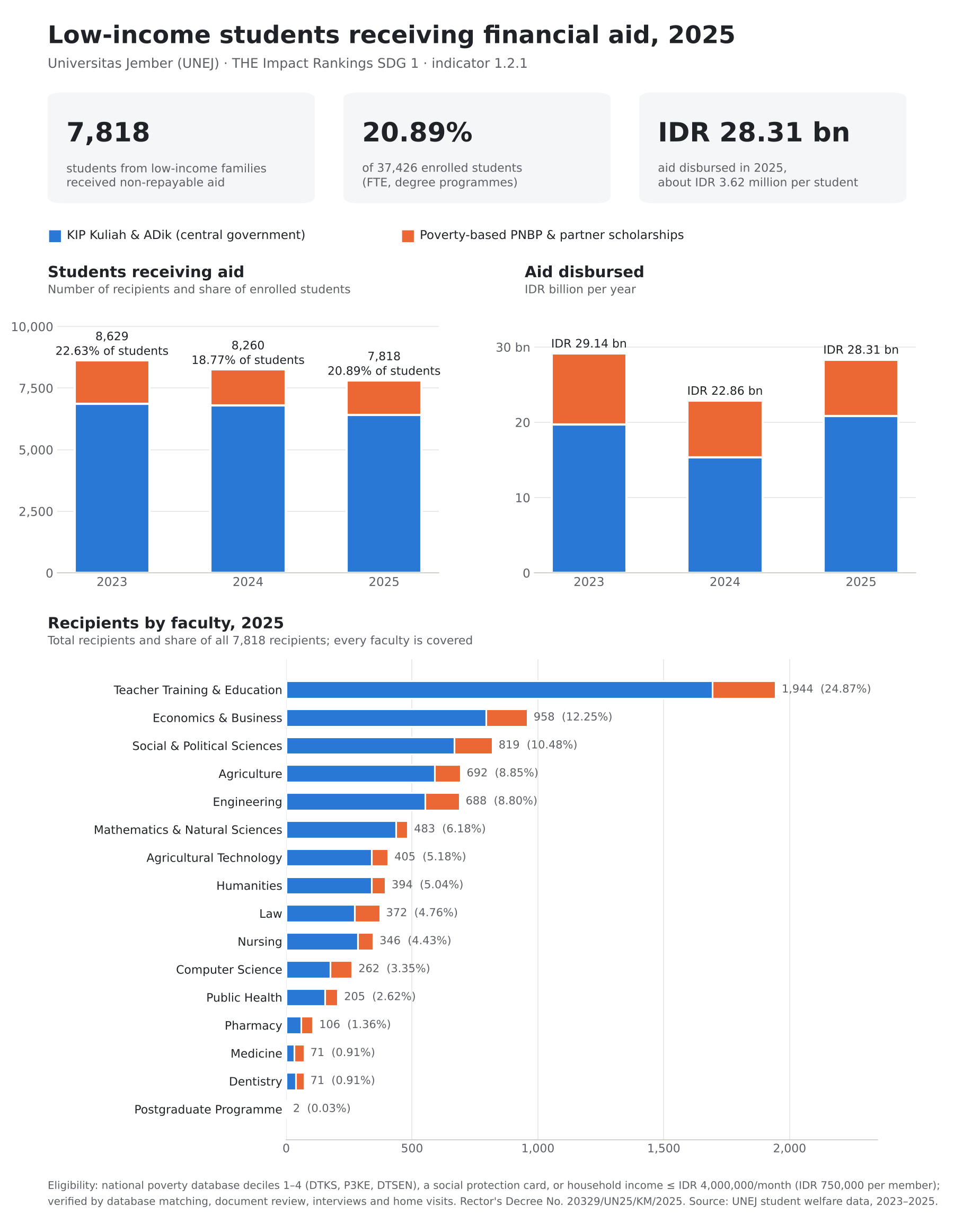
Universitas Jember (UNEJ) gives non-repayable financial aid to students from low-income families so that poverty does not stop them from enrolling and graduating. The aid is managed by the Student Welfare Working Group of the Bureau of Academic, Student and Alumni Affairs. In 2025, 7,818 students, or 20.89% of 37,426 enrolled students, received aid:
6,419 students through the government’s KIP Kuliah and ADik programmes (IDR 20,856,035,860);
1,399 students through poverty-based scholarships funded by university revenue (PNBP) and partners (IDR 7,458,000,000).
Total aid reached IDR 28.31 billion, or about IDR 3.62 million per recipient. This compares with IDR 22.86 billion for 8,260 students (18.77%) in 2024 and IDR 29.14 billion for 8,629 students (22.63%) in 2023. Recipients study in all 15 faculties and the Postgraduate Programme. The largest group is in the Faculty of Teacher Training and Education, with 1,944 students (24.87%). Aggregate data are published on this page free of charge and without login.
Policy and commitment
Rector’s Decree No. 20329/UN25/KM/2025 (15 September 2025) designates new students admitted through national selection as eligible KIP Kuliah recipients for 2025. Recital (a) states that the selection is intended for graduates with “adequate academic achievement whose parents/guardians are economically disadvantaged”. Its legal basis includes Law No. 12 of 2012 on Higher Education and Minister of Education and Culture Regulation No. 10 of 2020 on the Indonesia Smart Programme.
Announcements No. 12654/UN25/KM/2025 (13 June 2025, SNBP) and No. 15964/UN25/KM/2025 (24 July 2025, SNBT) list the verified KIP Kuliah recipients. The SNBT announcement follows Decree No. 0724/F2/KU.09.00/2025 of the Head of the Centre for Higher Education Funding and Assessment, Ministry of Higher Education, Science and Technology.
Rector’s Regulation No. 8090/UN25.1/TU.00.01/2025 (3 December 2025) governs tuition (UKT) adjustment, reduction and waiver, and stimulus scholarships from PNBP funds for economically disadvantaged students.
Recipient conditions: every KIP Kuliah recipient must study at UNEJ, sign a performance agreement with the university and not accept another scholarship. Any breach cancels the award.
Poverty criteria for recipients. A student qualifies through one of the following:
registration in a national poverty database (DTKS, P3KE or DTSEN) in deciles 1–4;
holding a social protection card (KIP for school, KKS or PKH);
a combined gross parental/guardian income of no more than IDR 4,000,000 per month, or IDR 750,000 per family member per month.
Income is checked against electricity bills, housing conditions and family assets.
Implementation in 2025
All aid is given as grants that do not have to be repaid. KIP Kuliah and ADik are funded by the central government and managed by the university, and living allowances are paid by the university directly to each recipient. Stimulus scholarships are funded from university PNBP revenue. Partner scholarships come from BAZNAS, local governments and industry.
Applicants from all admission routes (SNBP, SNBT and the independent SEMMABA selection) pass through four verification stages:
Data synchronisation: national ID numbers (NIK) are matched automatically against the Ministry of Social Affairs database (DTKS) and Puslapdik.
Document review: economic documents and a family-circumstance portfolio are assessed in the SIMKATMAWA system.
Verification and interview: the Scholarship Verification Team checks the facts and interviews applicants online or in person.
Home visits: random and periodic visits confirm that aid reaches the right students.
2025 timeline:
Date | Step |
|---|---|
23 June 2025 | KIP Kuliah recipients via SNBP announced; performance agreements due by 26 June |
25 July 2025 | KIP Kuliah recipients via SNBT announced; performance agreements due by 30 July |
15 September 2025 | Rector’s Decree No. 20329/UN25/KM/2025 issued |
Results. In 2025, 528 KIP Kuliah graduates were employed, in further study or running their own businesses.
References:
Announcement of Jember University's 2025 SNBT KIP-Lecture Course
Announcement of Jember University's 2025 SNBP Pathway KIP-Lectures
1.3.1 Bottom financial quintile admission target
UNEJ Allocates a Large Share of Its Admission Quota to Students from Low-Income Families
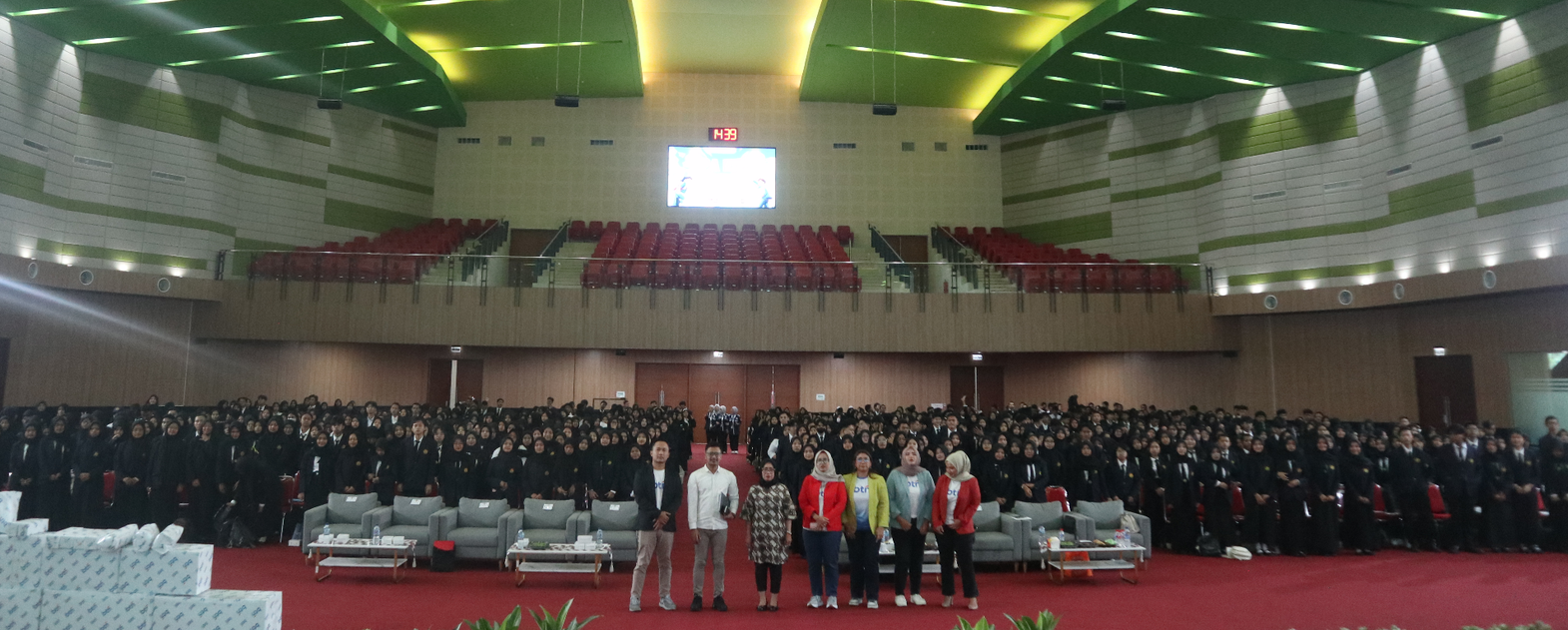
UNEJ Reserves 44% of Its Admission Quota for Students from Low-Income Families
New KIP Kuliah students at UNEJ’s 2025 student orientation.
Universitas Jember (UNEJ) sets a clear admission target for students from the poorest households. The target is delivered through the national KIP Kuliah programme, which admits students from the lowest-income groups and covers their tuition fees and living costs. KIP Kuliah places make up 44% of UNEJ’s total admission quota. The share is highest in the Faculty of Teacher Training and Education, at 56%. Even in the Faculty of Medicine, one of the most expensive programmes, 5–7% of places are reserved for students from low-income families. This means that low-income students can enter every field of study, not just low-cost programmes.
The target applies to both national admission routes. In 2025, 1,315 KIP Kuliah places were filled: 453 students through SNBP and 862 through SNBT. UNEJ verified every candidate before publishing the recipient lists, on 23 June 2025 for SNBP and 25 July 2025 for SNBT. Each recipient must study at UNEJ, sign a performance contract by 26 June (SNBP) or 30 July (SNBT), and not accept another scholarship; any breach cancels the award.
UNEJ also makes sure that cost does not block admission. University leaders have stated that no SNBP applicant is rejected or dismissed because of tuition costs. Students who cannot pay can pay in two or three instalments, apply for a lower UKT band or defer payment while their application is reviewed. Documents are published on this page free of charge and without login.
Policy and commitment
KIP Kuliah admission quota: 44% of UNEJ’s total admission quota; 56% in the Faculty of Teacher Training and Education; 5–7% in the Faculty of Medicine.
Decree No. 0724/F2/KU.09.00/2025 of the Head of the Centre for Higher Education Funding and Assessment, Ministry of Higher Education, Science and Technology, on the designation of KIP Kuliah recipients admitted through the National Test-Based Selection (SNBT) 2025.
UNEJ Announcement No. 12654/UN25/KM/2025 (13 June 2025) on verified KIP Kuliah recipients through SNBP, and No. 15964/UN25/KM/2025 (24 July 2025) on verified recipients through SNBT.
Rector’s Regulation No. 8090/UN25.1/TU.00.01/2025 (3 December 2025) on adjustment, reduction and waiver of UKT for economically disadvantaged students.
Leadership statement (27 April 2026): the Vice Rector for Academic Affairs and the Vice Rector for Student and Alumni Affairs confirmed that no SNBP applicant is rejected or dismissed because of tuition costs.
Implementation in 2025
Date | Step |
|---|---|
13 June 2025 | SNBP recipient announcement signed (No. 12654/UN25/KM/2025) |
23 June 2025 | Verified SNBP recipient list published; performance contracts due by 26 June |
24 July 2025 | SNBT recipient announcement signed (No. 15964/UN25/KM/2025) |
25 July 2025 | Verified SNBT recipient list published; performance contracts due by 30 July |
Data: KIP Kuliah admission targets and results, 2025
Unit | Target share of quota | KIP Kuliah places filled, 2025 |
|---|---|---|
University total | 44% | 1,315 (453 SNBP + 862 SNBT) |
Faculty of Teacher Training and Education | 56% | — |
Faculty of Medicine | 5–7% | — |
References:
Announcement of Jember University's 2025 SNBP Pathway KIP-Lectures
Announcement of Jember University's 2025 SNBT KIP-Lecture Course
1.3.2 Bottom financial quintile student success
From Financial Challenges to Graduation: Successful KIP Kuliah Students at UNEJ
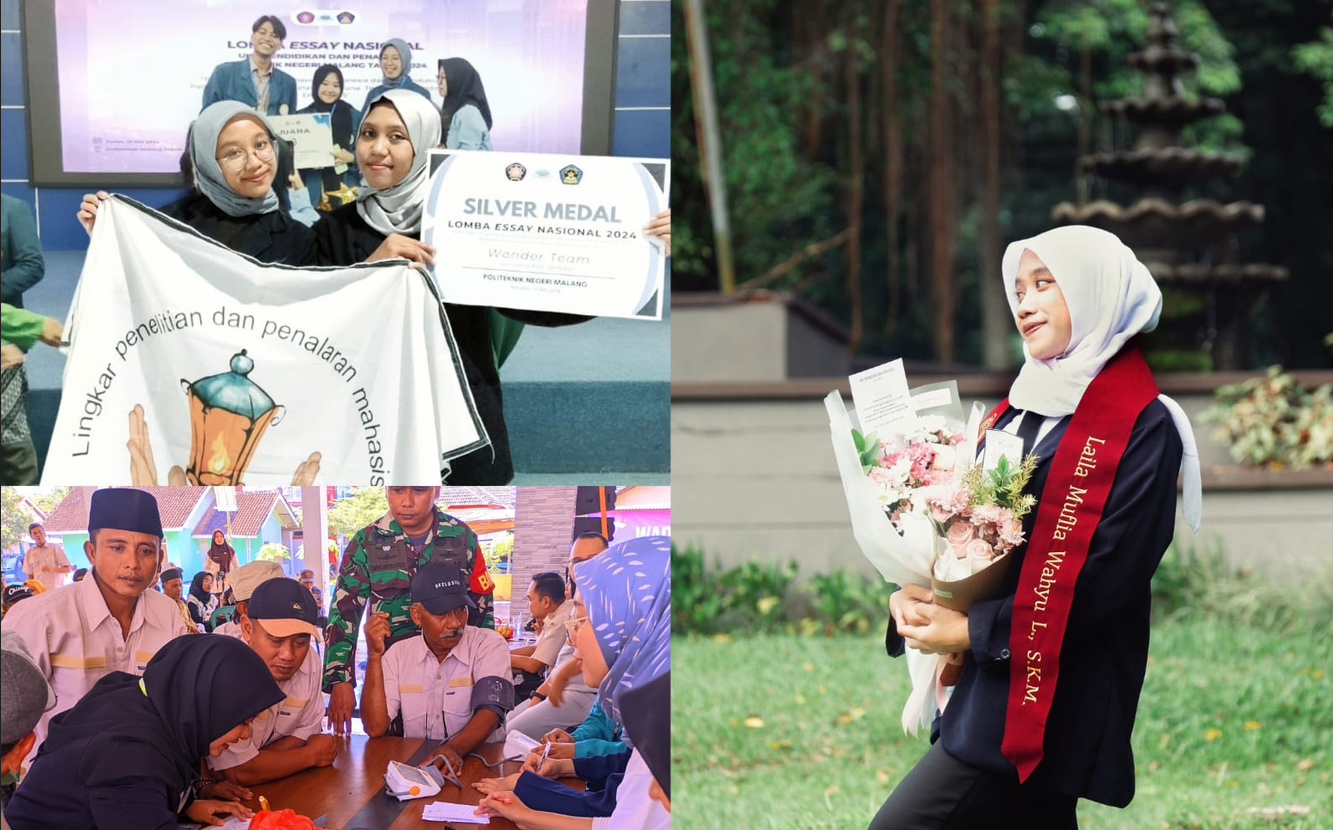
KIP Kuliah graduates at a UNEJ graduation ceremony.
Universitas Jember (UNEJ) monitors the progress and completion of students from the poorest households and links their results to the university’s graduation targets. Every KIP Kuliah recipient signs a performance agreement with the university. The agreement requires academic results to be reported every semester and at least 75% attendance at compulsory development activities. In 2025, new recipients signed their agreements by 26 June (SNBP) and 30 July (SNBT). KIP Kuliah managers review each recipient’s results every semester. After graduation, outcomes are tracked through the university’s annual tracer study, by scholarship scheme.
The results show that low-income students complete their studies with strong grades. At the Period IV graduation of the 2023/2024 academic year, all 169 KIP Kuliah graduates achieved a GPA above 3.00, with an average of 3.60. The highest GPA among them was 3.99, earned by the daughter of a small-scale farmer. Another KIP Kuliah recipient, a 2022 student of the Faculty of Public Health whose parents earn an irregular income as a trader and a seamstress, graduated with a GPA of 3.87.
Graduates also move into work and further study. In 2025, 528 KIP Kuliah graduates were employed, in further study or self-employed: 462 employed (87.5%), 41 in further study (7.8%) and 25 self-employed (4.7%), with a median monthly income of IDR 2.6 million. Another 236 graduates from the two lowest UKT bands reached the same outcomes, with a median monthly income of IDR 2.5 million.
UNEJ also sets a university-wide graduation target. Its 2026 performance agreement commits to at least 10,000 graduates, about 25% of its more than 42,000 active students, and to identifying barriers that delay graduation.
Policy and commitment
Performance agreement between UNEJ and every KIP Kuliah recipient: academic results reported every semester and at least 75% attendance at compulsory development activities. For the 2025 cohort, the deadlines were 26 June (SNBP) and 30 July (SNBT).
UNEJ performance agreement 2026: at least 10,000 graduates and identification of barriers that delay graduation.
Implementation in 2025
Academic monitoring: KIP Kuliah managers review each recipient’s grades every semester.
Tracer study: the annual survey reports employment, further study, self-employment and income by scholarship scheme.
Data: outcomes of low-income graduates, 2025 tracer study
Scheme | Employed | Further study | Self-employed | Total | Median monthly income (IDR) |
|---|---|---|---|---|---|
KIP Kuliah | 462 (87.5%) | 41 (7.8%) | 25 (4.7%) | 528 | 2,600,000 |
Lowest UKT bands (UKT 1–2) | 198 (83.9%) | 21 (8.9%) | 17 (7.2%) | 236 | 2,500,000 |
Data: academic results of KIP Kuliah graduates, Period IV graduation, 2023/2024 academic year
Indicator | Result |
|---|---|
KIP Kuliah graduates | 169 |
Graduates with GPA above 3.00 | 169 (100%) |
Average GPA | 3.60 |
Highest GPA | 3.99 |
References:
169 KIP-K Recipients, Graduated at Graduation Period IV, Jember University, all with GPA above 3.00
UNEJ Agrees to Performance Agreement, Encourages Collaborative Leadership
Not Just a 3.87 GPA: Tracks of Achievements and Journeys of Jember University KIP-K Students
1.3.3 Low-income student support
More Than Tuition Fees: UNEJ Supports the Daily Needs of Students from Low-Income Families
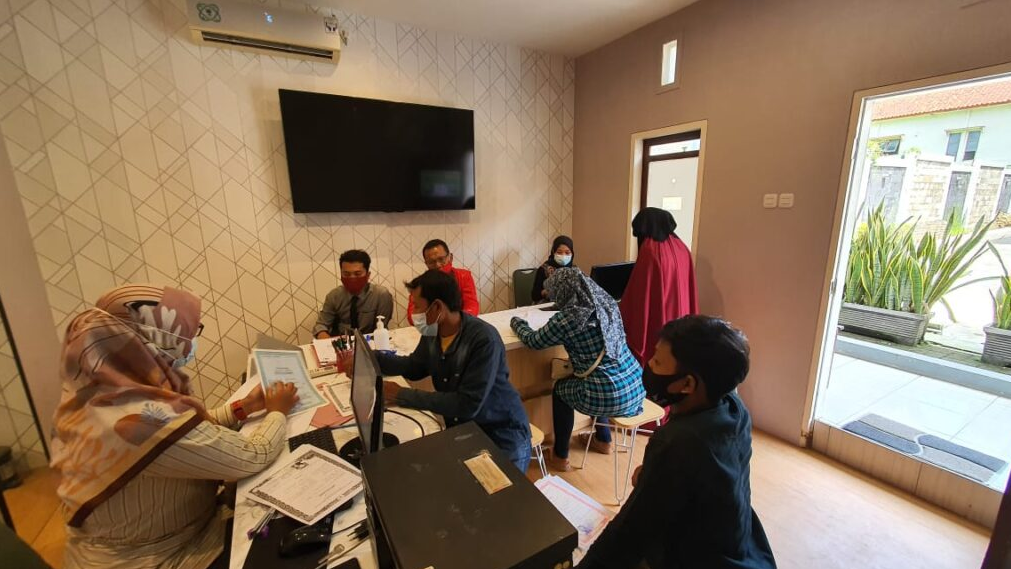
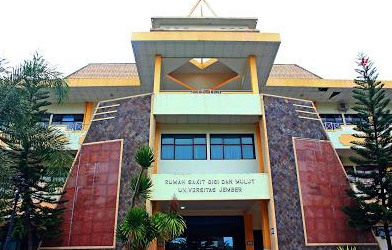
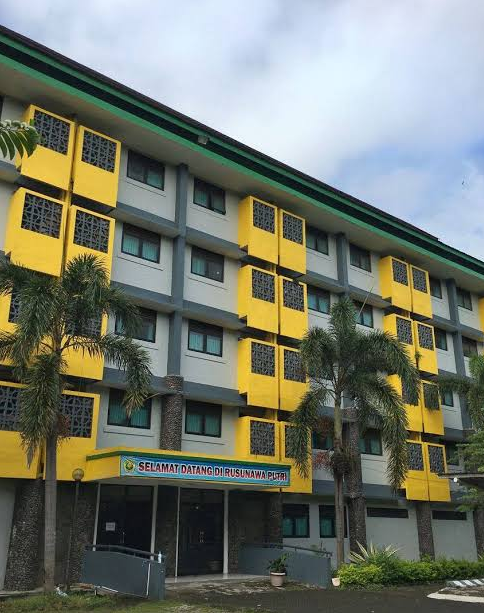
More than Tuition: UNEJ Helps Students from Low-Income Families with Fees, Housing, Healthcare and Legal Aid
The on-campus student residence (Rusunawa) offers furnished rooms from IDR 150,000 per month.
Tuition is only one part of the cost of university for students from low-income families. Rent, healthcare and unexpected problems can also force them to leave. Universitas Jember (UNEJ) helps these students stay enrolled through four kinds of support: tuition set by family income, flexible payment, affordable housing on campus, and free legal aid.
Tuition set by family income. UNEJ charges tuition (UKT) in six bands (Bands I–VI), set by Rector’s Decree No. 649/UN25/KU/2025. New students who choose the “assigned UKT” option submit an income statement from their neighbourhood head (RT/RW), and their band is set according to family income. Band I costs only IDR 500,000 per semester in every study programme. KIP Kuliah recipients can register without paying tuition at all.
Flexible payment when family finances change. Under Rector’s Regulation No. 8090/UN25.1/TU.00.01/2025, students whose family income falls can apply through the academic information system for one of three options:
move to a lower UKT band;
pay in two or three instalments;
defer payment until before the mid-semester examinations.
For the odd semester of 2025/2026, a letter from the Vice Rector for Academic Affairs also gave a 50% UKT reduction to final-year students who are completing their thesis: bachelor’s and D4 students in semester 9 or later, and D3 students in semester 7 or later, taking no more than 6 credits. Each option applies for one semester and is reviewed by faculty and university officials.
Affordable housing. The university’s Business Development Agency (BPU) runs separate residences for male and female students on campus. Each room houses up to three students and is furnished with beds, study desks, chairs, wardrobes and a bathroom. Monthly rent starts at IDR 150,000 for male students and IDR 155,000 for female students.
Free legal aid. The Legal Aid and Services Bureau (BPBH) of the Faculty of Law has operated since 2011 and is accredited grade A as a legal aid provider for 2025–2027. It gives eligible low-income clients free consultation, mediation, document drafting and court representation. It serves clients in person, online and at the Legal Aid Post of the Jember District Court, and handled 1,720 cases between 2022 and 2024.
Healthcare. The UNEJ Dental and Oral Hospital (RSGM) has provided 24-hour services, including emergency care, laboratory services and ambulance support, since March 2019. Campus health services work with nearby community health centres.
Policy and commitment
Rector’s Decree No. 649/UN25/KU/2025 on tuition fees for new bachelor’s and vocational students admitted through SNBP and SNBT in 2025: six UKT bands, Band I IDR 500,000 per semester.
Rector’s Regulation No. 8090/UN25.1/TU.00.01/2025 (3 December 2025) on adjustment, reduction and waiver of UKT and stimulus scholarships from PNBP funds for economically disadvantaged students.
Letter of the Vice Rector for Academic Affairs No. 3963/UN25.1/TU.00.01/2025 (25 June 2025) on the 50% UKT reduction and UKT/SPP payment alternatives for the odd semester 2025/2026.
Decree of the Dean of the Faculty of Law No. 0097/H25.1.1/TU.2/2011 establishing BPBH; SOP for Free Legal Consultation No. 028/ADM/V/2022; grade A accreditation as a legal aid provider for 2025–2027 (Decree of the Minister of Law No. M.HH-6.HN.04.03 of 2024, 27 December 2024).
Implementation in 2025
UKT relief: students apply each semester through the academic information system. Previous bills must be settled first, and faculty and university officials approve, redirect or reject each application.
Legal aid: BPBH serves clients in person, online and at the Legal Aid Post of the Jember District Court.
Housing: BPU manages the residences and sets the rent.
Data: support services for low-income students, 2025
Service | What students receive | Free or subsidised | Eligibility |
|---|---|---|---|
UKT Band I | Lowest tuition rate, IDR 500,000 per semester | Subsidised | Income statement from RT/RW (UNEJ format) |
KIP Kuliah registration | Registration without paying tuition | Free | KIP Kuliah recipient |
UKT relief | Lower UKT band, 2–3 instalments, deferral until before mid-semester exams | Subsidised | Change in family finances; previous bills settled |
50% UKT reduction | Half of the semester’s tuition waived | Subsidised | Bachelor’s/D4 semester ≥ 9 or D3 semester ≥ 7; maximum 6 credits |
Student residence (Rusunawa) | Furnished shared room, up to three students | Subsidised (IDR 150,000 male / IDR 155,000 female per month) | Registered students |
Legal aid (BPBH) | Consultation, mediation, document drafting, court representation | Free | Low-income clients with supporting documents |
References
1.3.4 Bottom financial quintile student support
More Than Scholarships: UNEJ Guides and Trains KIP-K Students through PAMADIKSI
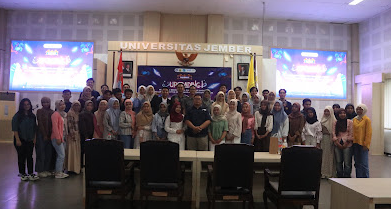
PAMADIKSI public speaking and graphic design training for KIP Kuliah students, 20 September 2025.
Financial aid opens the door to university, but students from the poorest households also need guidance, skills and a supportive community to finish their studies. Universitas Jember (UNEJ) provides this through PAMADIKSI, the association of UNEJ Bidikmisi and KIP Kuliah recipients. Development activities are compulsory: under the performance agreement that every KIP Kuliah recipient signs with the university, students must attend at least 75% of them.
A structured programme across the 2025 academic year. PAMADIKSI ran four development activities in 2025, each building on the last:
SAPA KIP-K 2025 (9 November, UNEJ Auditorium) was the entry point for the new cohort. It explained recipients’ rights and obligations and the scholarship rules, including what can cancel an award, and taught practical skills such as managing the monthly living allowance, academic ethics and study strategies.
Upgrading I (23 February) trained students in organisational management, leadership, vision and mission.
Upgrading II (23 August, CDAST North) developed leadership and communication through an alumni session and debate practice.
PAMADIKSI training (20 September, CDAST South) taught public speaking and graphic design, skills that students use in their studies and in the job market.
Together, these activities help students manage their money, meet their academic obligations and build the confidence and skills they need to graduate and find work. The approach continues to grow: in May 2026, UNEJ and BAZNAS launched Z-Coffee, a social enterprise run by affirmative-scholarship students whose profits fund further scholarships.
Policy and commitment
Performance agreement between UNEJ and every KIP Kuliah recipient: at least 75% attendance at compulsory development activities and academic results reported every semester.
Implementation in 2025
Delivery: PAMADIKSI runs the activities with the university’s student affairs office, and KIP Kuliah managers monitor attendance under the performance agreement.
Sequence: SAPA KIP-K introduces each new cohort; follow-up training builds communication, creativity and leadership skills throughout the year.
Data: development activities for KIP Kuliah students, 2025
Date (2025) | Activity | Venue | Focus |
|---|---|---|---|
23 February | Upgrading I | UNEJ | Organisational management, leadership, vision and mission |
23 August | Upgrading II | CDAST North, UNEJ | Leadership and communication, alumni session, debate practice |
20 September | PAMADIKSI training | CDAST South, UNEJ | Public speaking and graphic design |
9 November | SAPA KIP-K 2025 | UNEJ Auditorium | Orientation for new recipients: rights and obligations, scholarship rules, financial management, academic ethics, study strategies |
References
SAPA KIP-K: Orientation for New Recipients (PAMADIKSI, December 2025)
Documentation of Upgrading I, PAMADIKSI 2025 (PAMADIKSI, February 2025)
https://pamaksiunej.blogspot.com/2025/12/kegiatan-sapa-kip-k-pembekalan-dan.html
https://pamaksiunej.blogspot.com/2025/10/training-bisnis-pamaksi-2025.html
https://pamaksiunej.blogspot.com/2025/10/pada-tangan-23-augustus-2025-telah.html
https://pamaksiunej.blogspot.com/2025/02/documentasi-upgrading-1-pamaksi-2025.html
1.3.5 Low or lower-middle income countries students
UNEJ Opens Its Doors to Students from Developing Countries
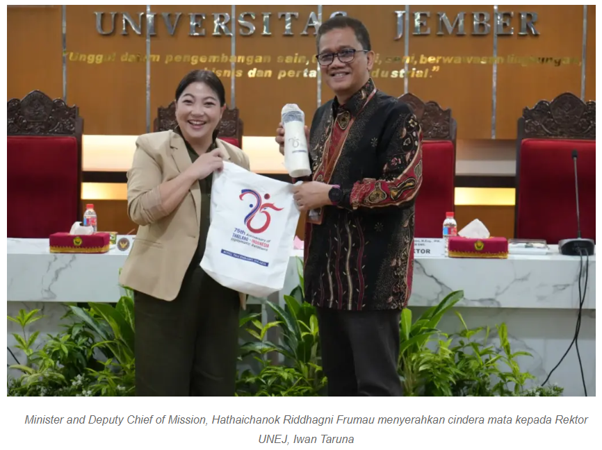
Tuition fees, immigration costs and travel can put study abroad out of reach for capable students from developing countries. Universitas Jember (UNEJ) reduces these costs through a scholarship for international postgraduate students. The scholarship is funded from the university’s own budget (DIPA UNEJ) and managed by the International Office.
What the scholarship covers. Rector’s Decree No. 15617/UN25/EP/2024 awards scholarships to international master’s students for the 2024/2025 academic year. The award runs for four semesters from the odd semester of 2024/2025, so it covered recipients throughout 2025. It provides:
full tuition (SPP) waiver for four semesters;
payment of the limited stay permit (KITAS);
50% of the multiple exit re-entry permit (MERP);
a return ticket home.
Recipients who have not graduated by the fourth semester pay their own fees from then on, which encourages on-time completion. Under the UNEJ Partial Scholarship scheme, the International Office also provides health insurance, airport pick-up, an Indonesian language course and an optional shared room in the student dormitory.
How recipients are selected. Applicants apply through the university admission system with their degree certificate, transcript, financial guarantee letter, recommendation letter, motivation letter and English proficiency certificate, and may be interviewed online. Successful applicants are confirmed by Rector’s decree. For the 2024 intake, Rector’s Decree No. 15587/UN25/EP/2024 (27 June 2024) admitted four master’s candidates through the international selection route. Scholarships went to the three candidates who scored at least 70 in the selection, with scores of 71.43 to 93.88.
Students from developing countries in 2025. In 2025, UNEJ enrolled international degree students from four countries. Two of them come from countries classified by the World Bank as low or lower-middle income: Sudan (low income) and Pakistan (lower-middle income).
Policy and commitment
Rector’s Decree No. 15617/UN25/EP/2024 on international students receiving master’s scholarships, academic year 2024/2025: four-semester tuition waiver, KITAS fee, 50% MERP fee and return ticket, funded by DIPA Universitas Jember.
Rector’s Decree No. 15587/UN25/EP/2024 (27 June 2024) on candidates admitted to master’s programmes through the international student selection, 2024.
UNEJ Partial Scholarship (International Office): for international master’s and doctoral applicants; tuition waiver, health insurance, visa and residence permit reimbursement, airport pick-up, Indonesian language course and optional dormitory room; minimum GPA of 3.25 each semester.
Data: international degree students at UNEJ by country income group, 2025
Country | World Bank income group (FY2026) | Programme | Intake |
|---|---|---|---|
Sudan | Low income | Bachelor’s, Dentistry | 2024 |
Pakistan | Lower-middle income | Master’s, Agribusiness | 2025 |
Thailand | Upper-middle income | Master’s, Agribusiness (scholarship 2024/2025) | 2024 |
Algeria | Upper-middle income | Bachelor’s, Law | 2025 |
Students from low or lower-middle income countries: 2 of 4 (50%).
References
Rector’s Decree No. 15617/UN25/EP/2024 on International Students Receiving Master’s Scholarships, 2024/2025
Rector’s Decree No. 15587/UN25/EP/2024 on Admitted International Master’s Candidates, 2024
Partnership for Developing Countries (KNB) Scholarship – International Office
1.4.1. Local start-up assistance
Growing Local Businesses: UNEJ Trains and Supports Village Businesses and Small Enterprises
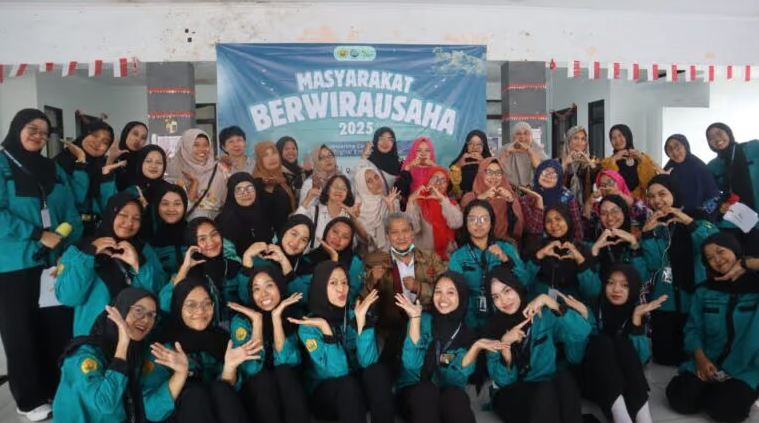
KOBER DESA links UNEJ’s expertise with villages to strengthen local economies.
Many small business owners in Jember and nearby regencies have products to sell but lack business knowledge, digital skills, licences and access to markets. Universitas Jember (UNEJ) helps them start and grow financially and socially sustainable businesses through free training, mentoring and technology transfer. The work is coordinated by the Institute for Research and Community Service (LP2M) and reaches 447 partner villages and urban wards designated by Rector’s Decree No. 3237/UN25/KL/2025. All training is free for participants.
Village partnerships. Through KOBER DESA (“Working Together for Villages”), launched by LP2M in December 2023 with the regency governments of Jember, Lumajang, Bondowoso and Situbondo, UNEJ links its experts with 235 villages to develop local economic potential.
Technology and know-how for small enterprises. In 2025, 68 lecturer-led community service projects partnered with local micro, small and medium enterprises across the Tapal Kuda region. They produced 129 innovation products now in use, including new production methods, appropriate technologies, digital applications and business models.
Measurable results in villages. In Kalibaru Manis Village, Banyuwangi, the student programme Paseban Kawis (PPK Ormawa) set up a village creative business centre. It helped eight local businesses register formally and seven products gain certification, and average entrepreneur income rose by about 20%, from IDR 2.3 million to IDR 2.76 million per month.
Licensing and digital skills. Through the Collaborative Community Service Programme (KKN Kolaboratif) with the Jember Regency Government, UNEJ students helped village businesses obtain business identification numbers (NIB), use digital marketing and strengthen village-owned enterprises (BUMDes) in Ajung, Tempurejo, Glagahwero and Sidomekar. UNEJ sent 945 of the 3,078 students deployed on 17 July 2025.
On 30 August 2025, the Faculty of Public Health ran MASBER 2025 in Kebonsari, Jember, under the theme “Empowering Communities through Digital Entrepreneurship”. Participants learned digital marketing and small business financial management, and were guided step by step in opening an online shop on the ShopeeFood Partner app.
On 28 September 2025, the Faculty of Economics and Business held the “UMKM Naik Kelas” seminar in the Ir. Soekarno Room to help micro and small business owners plan how to grow their businesses.
Policy and commitment
Rector’s Decree No. 3237/UN25/KL/2025 on UNEJ partner villages: 447 villages and urban wards.
KOBER DESA partnership with the regency governments of Jember, Lumajang, Bondowoso and Situbondo, launched by LP2M in December 2023, covering 235 villages.
Implementation in 2025
Support combines three channels:
Lecturer community service: 68 projects with local MSMEs.
Student programmes: PPK Ormawa and KKN Kolaboratif.
Faculty activities: MASBER and the UMKM Naik Kelas seminar.
Entrepreneurs receive production methods, equipment and digital applications, together with help in business licensing and product certification.
Data: business support for local communities, 2025
Programme | Date | Location | Support provided | Results |
|---|---|---|---|---|
MSME partnership community service (68 projects) | 2025 | Tapal Kuda region | Production methods, appropriate technology, digital applications, business models | 129 innovation products in use |
PPK Ormawa Paseban Kawis | 2025 | Kalibaru Manis, Banyuwangi | Village creative business centre, product certification | 8 businesses registered, 7 products certified, income +20% |
KKN Kolaboratif with the Jember Regency Government | From 17 Jul 2025 | Ajung, Tempurejo, Glagahwero, Sidomekar | Business licensing (NIB), digital marketing, BUMDes | 945 UNEJ students deployed (of 3,078 from universities across Jember) |
MASBER 2025 (Faculty of Public Health) | 30 Aug 2025 | Kebonsari, Jember | Digital marketing, financial management, online shop set-up | 30 participants |
UMKM Naik Kelas seminar (Faculty of Economics and Business) | 28 Sep 2025 | Ir. Soekarno Room, UNEJ | Business development planning | 50 participants |
References
Bupati Jember Lepas Ribuan Mahasiswa KKN Kolaboratif 2025 (JatimTimes, 18 July 2025)
UMKM Naik Kelas Seminar, Faculty of Economics and Business, UNEJ
Rector’s Decree No. 3237/UN25/KL/2025 on UNEJ Partner Villages
Collaborating with 4 Regencies, LP2M University of Jember Launches the KOBER VILLAGE Program
1.4.2 Local start-up financial assistance
UNEJ Funds New Start-ups and Equips Local Small Businesses
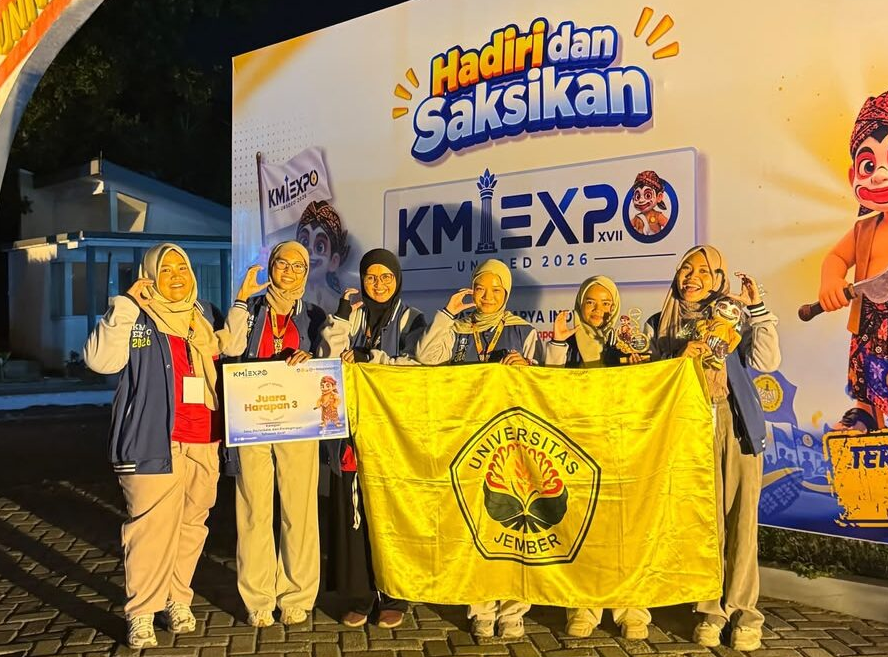
UNEJ entrepreneurs present their products at the national KMI Expo.
Limited starting capital is one of the main reasons new and small businesses fail to grow. Universitas Jember (UNEJ) provides early-stage funding in three ways. It gives equipment and technology to local micro and small enterprises, funds new start-ups from its own budget, and secures national grants for student-led businesses.
In-kind capital for local small enterprises. In 2025, UNEJ spent IDR 1,730,352,000 of community service funding on 68 projects with local micro and small enterprises in the Tapal Kuda region, an average of about IDR 25.4 million per project. The funds were used to buy equipment, production technology and digital tools, which were then handed over to the partner businesses. The businesses received this capital at no cost and did not have to repay it.
Seed funding for new start-ups. Through its Innovation-Based Start-up Programme, UNEJ funded six new start-ups in Jember in 2025, with a total of IDR 151,050,000, an average of IDR 25.2 million each and up to IDR 35.15 million for a single start-up. Proposals are selected competitively and funded until the business begins operating. All six were founded by UNEJ lecturers. Their products serve local farmers and households:
plant growth regulators;
a UV-resistant biopesticide;
a biofortified organic fertiliser;
activated carbon from durian peel for water purification;
an eco-friendly detergent made from soybean waste;
a low-cost IoT- and AI-based tree measuring device.
National grants for student businesses. UNEJ selects and nominates student business teams for the Student Entrepreneurship Development Programme (P2MW) of the Ministry of Higher Education, Science and Technology. It also assigns academic mentors and monitors how the grants are used. The 2025 recipients were confirmed in Letter No. 2300/B2/DT.01.03/2025 of the Directorate of Learning and Student Affairs (17 July 2025). From 2023 to 2025, 36 UNEJ student teams received P2MW funding, the highest number among universities in Jember Regency, and 20 of them (56%) were still operating after the programme ended.
Policy and commitment
Universitas Jember Internal Research and Community Service Guidelines 2025 (LP2M UNEJ): govern the community service grants used to buy equipment for partner businesses and the start-up funding scheme.
Letter No. 2300/B2/DT.01.03/2025 (17 July 2025) of the Directorate of Learning and Student Affairs on the 2025 P2MW funding recipients.
Implementation in 2025
Community service grants: lecturers propose projects with a named local business partner. Equipment and technology bought with the grant are handed over to that partner.
Start-up programme: proposals are selected competitively and funded up to early operation.
P2MW: UNEJ selects teams, assigns mentors and monitors the use of funds throughout the programme.
Data: start-ups funded by UNEJ, 2025
Start-up product | Faculty | UNEJ funding (IDR) |
|---|---|---|
IoT- and AI-based tree stem measuring device (AgriMeterV2) | Agricultural Technology | 35,150,000 |
Plant growth regulators (auxins, cytokinins, gibberellins, amino acids, phosphate) | Agriculture | 26,837,500 |
UV-resistant biopesticide (Beauveria bassiana and Metarhizium anisopliae) | Agriculture | 24,462,500 |
Durian-peel activated carbon for water purification (DuriCarb) | Engineering | 22,562,500 |
Biofortified organic fertiliser (KOMPOS-MAG+) | Agriculture | 22,325,000 |
Eco-friendly detergent from soybean waste (SoyaFlow) | Engineering | 19,712,500 |
Total (6 start-ups) | 151,050,000 |
Data: financial and in-kind support for local businesses, 2025
Support | Recipients | Amount (IDR) | Form |
|---|---|---|---|
Community service grants with local MSMEs | 68 projects with local micro and small enterprises | 1,730,352,000 | Equipment, production technology, digital tools |
Innovation-Based Start-up Programme | 6 new start-ups in Jember | 151,050,000 | Seed funding |
P2MW (2023–2025) | 36 UNEJ student teams; 20 still operating | Ministry grants | Grants, mentoring, training |
References
Universitas Jember Internal Research and Community Service Guidelines 2025 (LP2M UNEJ)
Letter No. 2300/B2/DT.01.03/2025 on the 2025 P2MW Funding Recipients
1.4.3 Programs for services access
UNEJ Brings Nutrition, Health, Clean Energy and Water Services to Low-Income Villages
Many low-income households in the Tapal Kuda region still have limited access to basic services. In 2025, Universitas Jember (UNEJ) ran programmes in four areas: child and family nutrition, maternal and infant health, clean energy for cooking and lighting, and water. The programmes were delivered directly by UNEJ lecturers and students together with village governments, integrated health posts (Posyandu) and community groups, and were free for the communities served.
Nutrition and health.
Stunting prevention: through the Collaborative Community Service Programme (KKN Kolaboratif) with the Jember Regency Government and the Jember Health Office, 945 UNEJ students carried out stunting prevention activities at all 2025 KKN Kolaboratif sites in Jember.
Posyandu support: UNEJ supported Posyandu in three areas of Jember:
Tegalgede: microgreens for family nutrition, with cadres from five Posyandu in Tegalgede ward;
Sumberjati (Silo): maternal and infant health, to reduce complications;
Kemuning Lor: food gardens to prevent stunting.
Clean energy and water. Through community service grants, UNEJ built five renewable energy facilities with village communities in three regencies. Each uses local resources such as cow manure, coconut husk, river flow or sunlight:
Lojejer (Jember): a cow-manure biogas digester with livestock farmers, built between June and October 2025, supplying cooking fuel;
Kemiren (Banyuwangi): a coconut-husk biogas digester in the Osing customary village, using a 6,000-litre geomembrane reactor, supplying cooking fuel;
Sumberwringin (Bondowoso): a micro-hydro power plant supplying electricity to the local tourism awareness group (Pokdarwis);
Kedawung (Lumajang): a solar submersible pump giving the Al-Barokah Farmers’ Group access to water;
SMKN 1 Sempol (Bondowoso): a 200 Wp micro solar PV system supplying electricity for the vocational school.
Complementary service: free legal aid. Since 2011, the UNEJ Faculty of Law has run the Legal Services and Aid Bureau (BPBH FH UNEJ). It offers free consultations, document preparation, mediation and court assistance to eligible low-income residents, handling around 400 cases or services a year. BPBH also runs a Legal Aid Post (POSBAKUM) at the Jember District Court and an online legal aid service. This helps protect poor households from legal problems over land, family matters or debt.
Policy and commitment
KKN Kolaboratif agreement with the Jember Regency Government: Rector’s Decree No. 12716/UN25/KL/2018, renewed by No. 4242/UN25/KL/2022.
Rector’s Decree No. 3237/UN25/KL/2025 on UNEJ partner villages.
Implementation in 2025
Lecturers and students deliver the programmes directly with village governments, Posyandu, farmers’ groups and schools.
Energy and water facilities are built through community service grants and handed over to the community groups that run them.
All services are free of charge for the communities served.
Data: basic service programmes, 2025
Programme | Basic service | Location | Partner | People served |
|---|---|---|---|---|
Stunting prevention (KKN Kolaboratif) | Child nutrition | All 2025 KKN Kolaboratif sites, Jember | Jember Health Office | Communities at KKN sites (945 UNEJ students deployed) |
Tegalgede Posyandu | Family nutrition (microgreens) | Sumbersari, Jember | Posyandu | Cadres of five Posyandu in Tegalgede ward |
Sumberjati Posyandu | Maternal and infant health | Silo, Jember | Posyandu | Posyandu cadres |
Kemuning Lor Posyandu | Stunting prevention (food gardens) | Jember | Posyandu | Posyandu cadres |
Cow-manure biogas | Cooking fuel | Lojejer, Jember | Livestock farmers | Livestock farmers’ group |
Coconut-husk biogas (6,000 L) | Cooking fuel | Kemiren, Banyuwangi | Osing customary village | Residents of Kemiren village |
Micro-hydro power plant | Electricity | Sumberwringin, Bondowoso | Local tourism business | Tourism awareness group (Pokdarwis) |
Solar submersible pump | Water access | Kedawung, Lumajang | Al-Barokah Farmers’ Group | Farmers’ group |
200 Wp micro solar PV system | Electricity | SMKN 1 Sempol, Bondowoso | Vocational school | Students of SMKN 1 Sempol |
BPBH FH UNEJ and POSBAKUM | Free legal aid | Jember | Jember District Court | About 400 cases or services a year |
References
UNEJ students carry out stunting prevention through KKN Kolaboratif (JatimTimes, 18 July 2025)
Cow-manure biogas in Lojejer Village (JAMSI journal, 2025)
Coconut-husk biogas in Kemiren Village (Abdi Insani journal; TIMES Indonesia, 22 December 2025)
Legal Services and Aid Bureau, Faculty of Law, UNEJ (BPBH FH UNEJ)
Universitas Jember Social, Economic and Environmental Impact Report 2025
1.4.4 Policy addressing poverty
UNEJ Shapes Data-Based Poverty Policy at Local, Provincial and National Level
Jember Regency has the second-highest number of people living in absolute poverty in East Java. Universitas Jember (UNEJ) helps shape poverty policy at three levels. Locally, it works under formal agreements with the Jember Regency Government. At provincial level, it contributes through a policy study, and nationally through forums held with central government agencies.
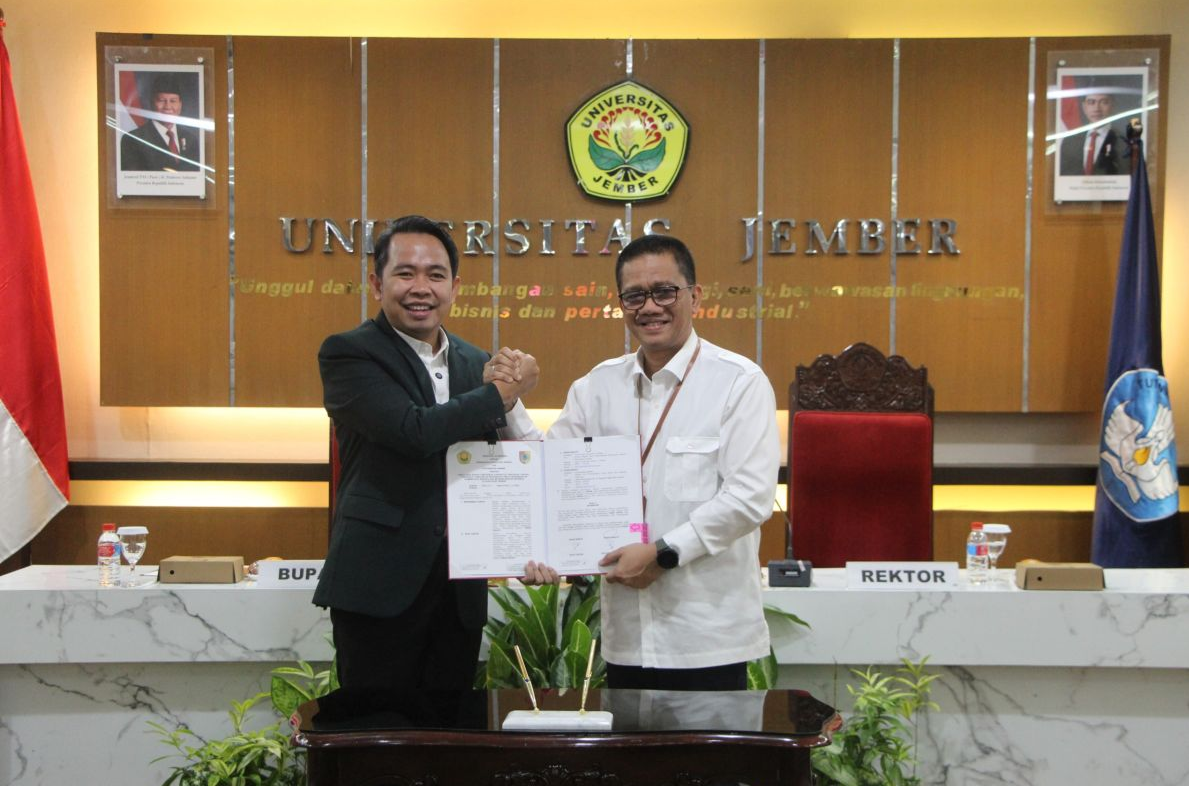
Local level: a formal role in regency poverty planning. On 6 October 2025, UNEJ and the Jember Regency Government signed a memorandum of understanding (MoU) on reducing extreme poverty at the UNEJ Rectorate Building. Under the MoU, the Regent asked UNEJ to provide experts to support data-based development planning. The aim is for regency programmes to target poverty directly and stay consistent through political change. The regency will direct programmes across its offices, from education and tourism to agriculture, towards about 124,000 people in welfare deciles 1 and 2, who are classified as living in extreme poverty. Its target is to reduce absolute poverty to below 200,000 people within five years. UNEJ provides expertise in the social sciences, humanities, engineering and health. The Rector described the partnership as part of the university’s Three Pillars of Higher Education (Tridharma), with UNEJ acting as a “water tower” for the community rather than an “ivory tower”.
The MoU builds on a partnership that has run since 2018. Under the Collaborative Community Service Programme (KKN Kolaboratif), annual themes are set jointly with the Regional Development Planning Agency (Bappeda) and six regional government offices. Since 2022 the themes have focused on organising poverty data. In 2025, the programme helped the Social Affairs Office verify poverty data. The programme is based on Rector’s Decree No. 12716/UN25/KL/2018, renewed by No. 4242/UN25/KL/2022.
Provincial level: policy recommendations for East Java. Public Administration lecturers from the UNEJ Faculty of Social and Political Sciences, working with Universitas 17 Agustus 1945 Surabaya, wrote a collaborative study on poverty alleviation in East Java Province. It was presented at the International Conference on Multidisciplinary Issues (INCOMI) 2025, which the Faculty hosted on 30 October 2025. The study makes three recommendations: more accurate poverty data, community involvement in programme planning, and pentahelix coordination among government, business, academia, communities and the media.
National level: input to central government agencies.
25 November 2025: LP2M UNEJ hosted the national seminar “Coffee Industrialisation and Poverty Alleviation” with the national Poverty Alleviation Acceleration Agency (BP Taskin) and the Jember Regency Government. UNEJ gave academic input on village-based downstream coffee processing and social forestry. The seminar produced a joint commitment to use coffee, grown on about 30,000 ha in the region, as an instrument for reducing poverty in Tapal Kuda.
November 2025: at the UNEJ Climate Change Conference, the Directorate General for the Acceleration of Development of Disadvantaged Regions asked UNEJ to study climate-resilient villages.
Policy and commitment
Memorandum of understanding between UNEJ and the Jember Regency Government on reducing extreme poverty (6 October 2025).
KKN Kolaboratif with the Jember Regency Government: Rector’s Decree No. 12716/UN25/KL/2018, renewed by No. 4242/UN25/KL/2022.
Implementation in 2025
UNEJ experts provide data and analysis for regency planning.
Six regional government offices help set and oversee the KKN Kolaboratif themes: Bappeda, the Education Office, the Health Office, the Office for Women’s Empowerment and Child Protection, the Office for Village Community Empowerment, and the Social Affairs Office.
KKN Kolaboratif students helped the Social Affairs Office verify poverty data.
Data: UNEJ involvement in poverty policy-making, 2025
Level | Activity | Date | UNEJ role | Outcome |
|---|---|---|---|---|
Local | MoU on reducing extreme poverty with the Jember Regency Government | 6 Oct 2025 | Expert input for data-based planning | Programmes directed at about 124,000 people in deciles 1–2; target of absolute poverty below 200,000 within five years |
Local | KKN Kolaboratif with Bappeda and six regional government offices | 2022–2025 | Joint theme setting; field data | Poverty data verified for the Social Affairs Office (2025) |
Provincial | Collaborative study on poverty alleviation in East Java, INCOMI 2025 | 30 Oct 2025 | Forum host; co-author of the policy study | Recommendations on data accuracy, community participation and pentahelix coordination |
National | National seminar “Coffee Industrialisation and Poverty Alleviation” with BP Taskin | 25 Nov 2025 | Host (LP2M); academic input | Joint commitment to use coffee (about 30,000 ha) to reduce poverty in Tapal Kuda |
National | UNEJ Climate Change Conference with the Directorate General for the Acceleration of Development of Disadvantaged Regions | Nov 2025 | Study of climate-resilient villages | UNEJ asked to study climate-resilient villages |
References
UNEJ, BP Taskin and the Regent of Jember Join Forces to Make Coffee the Main Weapon against Poverty in Tapal Kuda
A Collaborative Perspective on Poverty Alleviation in East Java Province, Indonesia (INCOMI 2025 Proceedings, Atlantis Press)
Director General of PPDT Encourages UNEJ to Study Climate-Resilient Villages
Universitas Jember Social, Economic and Environmental Impact Report 2025